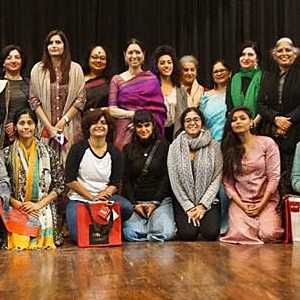
PB062273

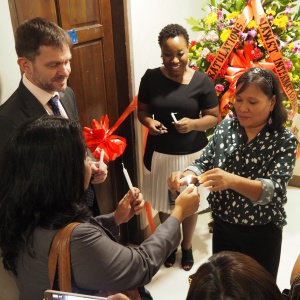
IAWRT has officially launched our new international office

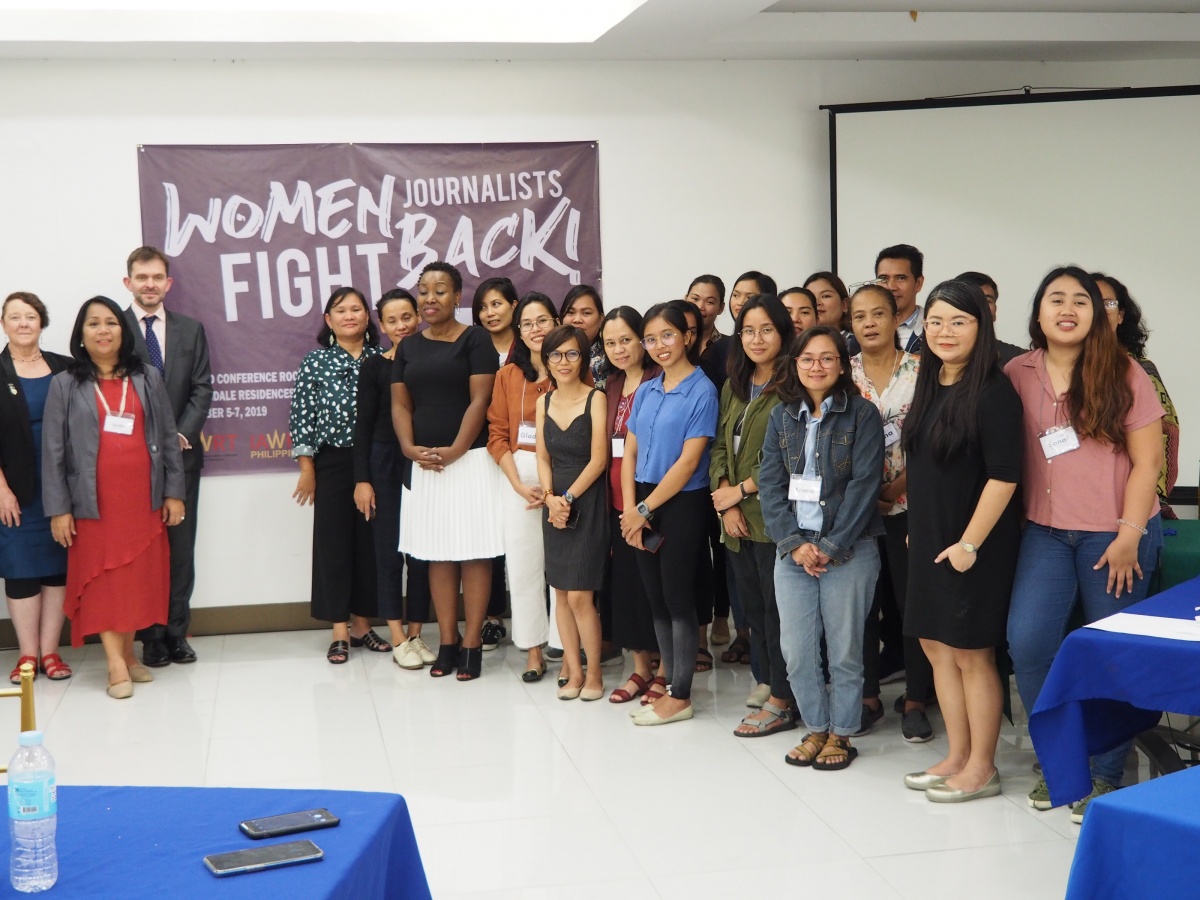
The launch in Quezon city in the Philippineswas part of a forum entitled Women Journalists Fight Back.

The event opening included comments from the Hon Quentin Biehler, Political Counsellor for the French Embassy in the Philippines who affirmed his country’s support for media freedom. The main forum presentation was about online harassment of women around the word.

The organisation has been operating a ‘virtual secretariat’ for the past five years, it has achieved a lot, but in order to increase efficiency and improve communications, it will now be based in the Philippines where one of our more active chapters is located.

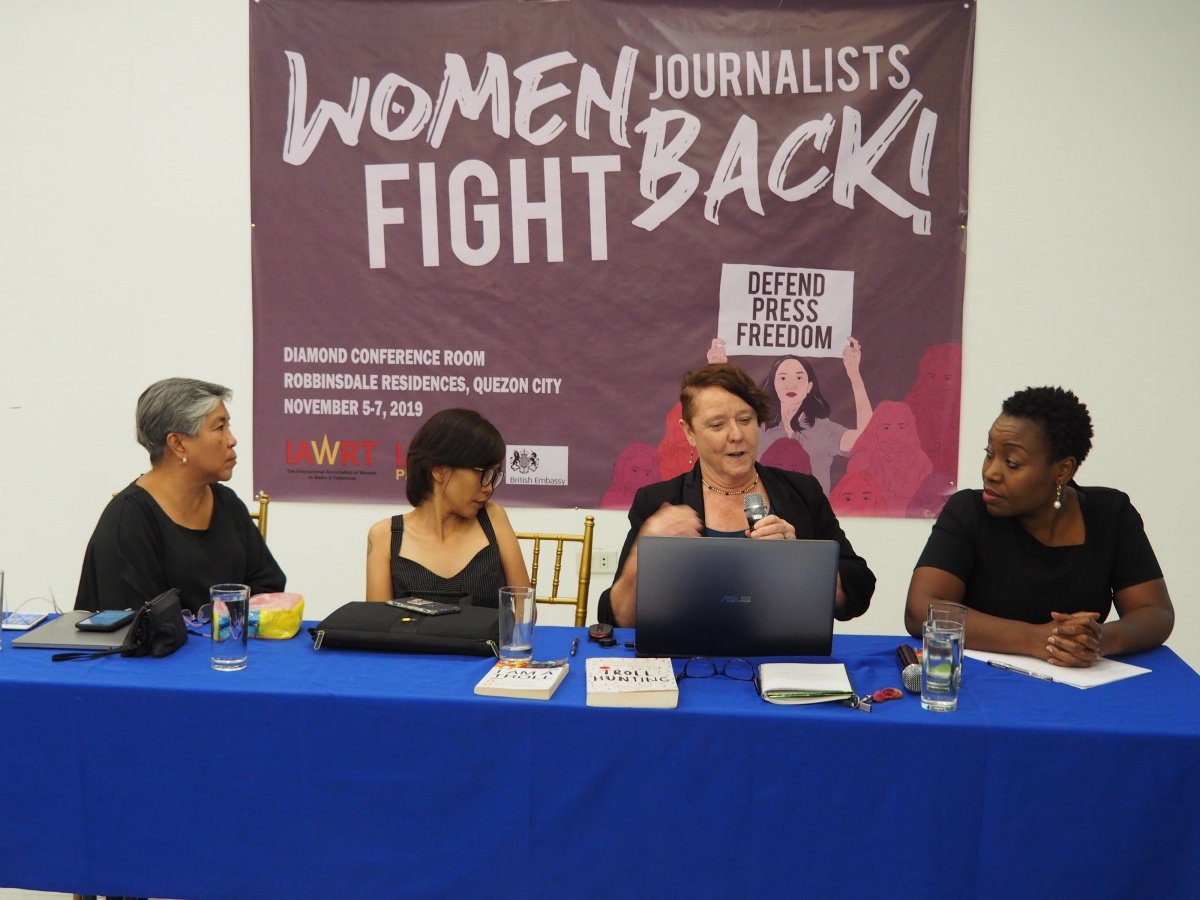
The forum included a session on online harassment of women journalists, with the panellists, Inday Espina-Varona, columnist and former chair of National Union of Journalists of the Philippines, Ronalyn Olea, a journalist from Bulatlat.com, Philippines  Nonee Walsh, IAWRT web journalist, based in Australia. and Violet Gonda, President of IAWRT

Each of them shared stories about the varying forms of online harassment or violence against media women which prompted a lively discussion on strategies to combat this increasing problem.

The session was chaired by Lynda Garcia the newly elected President of the IAWRT Philippines chapter and a teacher and researcher in journalism over the past four decades.

She facilitated a highly engaged discussion on safety issues and potential improvements to journalism education.

Jola Diones-Mamangun, IAWRT international’s finance officer presided over the official opening of the IAWRT international secretariat office.

The office was blessed by Fr Oliver Castor CSSSr and the ribbon cut with the Deputy Head of mission from the British Embassy in Manila, Alastair Totty. He told the launch dinner that British government valued he work of IAWRT and the support it is able to give to women working in important but difficult media jobs.  

The successful forum and opening event were very much thanks to the hard work of Jola, Lady Ann Salem International communications officer, Sanaf Marcelo, the finance officer, Janess Ellao the membership officer and all the great team of committed volunteers.

Media coverage:

Women journalists demand stop to online harassment


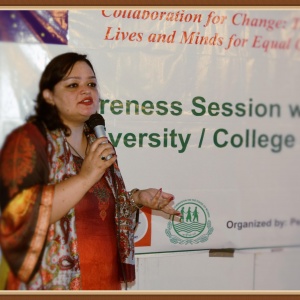
qudsia mahmood

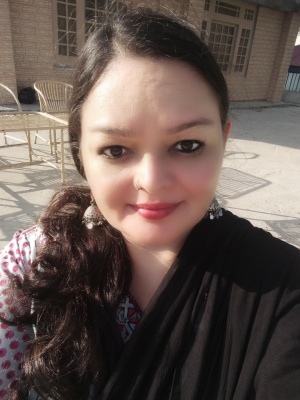
Qudsia Mahtab Mehmood

Islamabad, Pakistan

Development Journalist

What type of projects do you do?

I produce radio and television programs that tackle gender-based violence, and pressing issues affecting children and other marginalized groups. I also provide gender-sensitivity training for students and journalists. I have also designed and developed communication strategies for national-level government and donor-funded projects. Recently I have worked on educating communities about pro-women laws.

Why did this sort work interest you, and how did you get started?

Working with media has always been my passion. This pushed me to maximize its powers in amplifying the voices of women, children and marginalized groups, providing me with a sense of satisfaction that my work contributes towards genuine development for the people.

What part of this job do you like and find most satisfying?

I believe that solutions to the problems confronting communities can rise among their ranks. We work hard to ensure that it is people’s voice – their stories and narratives – that is aired. This includes traveling to communities near and far to get the stories straight from them, making our work even more meaningful.

What do you not like or find most challenging about working in this industry?

Development journalism is yet to be recognized in Pakistan. Such a branch of journalism entails investigative reporting that tackles real issues affecting the people. The challenge, however, is to sell these reports.

My strongest assets/skills, areas of knowledge, personality traits and values are….

I am truly blessed to have worked the way I wanted to, secure all the required trainings, and hone skills to get the work done. One of my strongest assets is courage and a deep understanding of issues rooted in our culture. I am an independent traveler and have worked in the most fragile environments in Pakistan.

Has IAWRT’s network of media women around the world helped or inspired you?

Whenever I face challenges, it comforts me that there are women in media around the world who are working in more sensitive places, under more dire circumstances, and facing all kinds of threats. As such, I know that not only can I relate to other women media but also get support from the group.

What are your long-term goals?

I don’t make long-term goals. I would rather focus on my efforts in making more aware and empowered communities.

What special advice do you have for other women seeking this type of work?

I have witnessed girls graduating with a degree in mass communication but are not pursuing it as a career. I encourage them to come forward and explore this field of work. There is a lot of work waiting to be done to make this society truly gender sensitive. We need more empowered voices in the media.

Do you have any special words of warning, or encouragement, based on your experience?

Learning is both key and a life-long process. Our contribution may not change the society at once. But at the end of it, every contribution counts.

Links to some of Qudsia’s work online:

Agent of Change

Cholistan Pakistan-Where water is life and no water,no life.

Trafficking of Women, Heart Breaking Reality

Roshni Ki Awaz

Transgender Community

My Childhood 

Personal website/profiles online

https://www.facebook.com/qudsia.mehmood

IAWRT impunity Nov 2 01

IAWRT condemns all attacks on journalists and media workers

IAWRT joins the annual observance of the International Day to End Impunity for Crimes Against Journalists on November 2.

At least 324 journalists were murdered worldwide in the past decade and no perpetrators have been convicted in 85% of these cases – according to the Committee to Protect Journalists’ Global Impunity Index 2019 ‘Getting Away With Murder’. The CPJ says 10 out of the 19 journalists killed in 2019 alone were murder cases. In 2019 alone, 19 journalists have been killed, with 10 of them murdered.

Forty-five women journalists (out of 1,357 killed) were killed since 2009 and 27 of these cases remain unsolved. 

In the CPJ index, four countries where IAWRT has country chapters rank in the top 14. Iraq ranked 3rd with 35 unsolved cases of journalist killings in a 10-year period. The Philippines ranked 5th with 40 unsolved cases, Afghanistan ranked 6th with 11 unsolved cases and India ranked 14 with 18 unsolved cases.

“IAWRT urges governments to bring perpetrators of crimes against journalists and media workers to justice, to curb impunity in their countries and to ensure that journalists can work freely and independently,” says Violet Gonda, President of IAWRT.

“Journalists continue to be killed for reporting the news and bringing information to the public, preventing effective education.”

“Societies suffer when journalists are attacked”

“Killings of journalists silence voices and impair the public’s need for information. The lack of justice served for these killings emboldens killers. Impunity leads to more killings. Killings daunt reporting and the search for truth. We must always call out and stand against killings of journalists and the culture of impunity that besiege countries around the globe.”

Gonda added: “IAWRT urges governments to bring perpetrators of crimes against journalists and media workers to justice, to curb impunity in their countries and to ensure that journalists, including women journalists, can work freely and independently.”

IAWRT remembers and pays tribute to women journalists killed on the International Day to End Impunity for Crimes Against Journalists.

  • Viktoria Marinova, a Bulgarian journalist, was raped, bashed, and suffocated and her body was found on October 6, 2018. She was looking into alleged fraud involving EU funds linked to big businessmen and politicians and prompted speculation that she may have been targeted as ‘a warning’;
  • Lyra McKee, a North Irish freelance journalist shot dead in Derry, Northern Ireland on April 18, 2019 while covering clashes in Creggan, a suburb of Londonderry (Derry). The ‘New IRA’, a dissident republican group, has admitted responsibility for her murder;
  • Norma Sarabia Garduza, killed on June 11, 2019, just two months after she reported on a series of violent crimes in Huimanguillo, Mexico and five years after she reported to police that she had received threats from local police officers after she covered alleged involvement of police in kidnappings.
  • Daphne Caruana Galizia, killed in a car bomb attack on Oct 16, 2017 for exposing corruption in Malta;
  • Gauri Lankesh, shot dead in India on September 25, 2017 for criticizing the woman’s place in the caste system;
  • Miroslava Breach, killed on March 23, 2017, an anti-corruption and human rights reporter for the Norte de Ciudad Juárez and La Jornada newspapers in Mexico;
  • Kim Wall, a Swedish journalist who was sexually assaulted and killed while working on a submarine story in August 2017;

Many other women journalists also face legal persecution and other forms of harassments for their work.

The IAWRT Iraq-Kurdistan chapter has also appealed for support as the situation in their country has reached a very dangerous stage

The chapter head Awaz Salim says “a day does not pass without militias targeting young women, activists and media workers.”

Journalists in Kurdistan are also having their rights violated. An IAWRT Iraq-Kurdistan member was put on trial for the ‘misuse of electronic devices’ over a Facebook post.

In the Philippines, journalist Anne Krueger was unlawfully arrested with 56 others in simultaneous raids on various offices in Bacolod City in the Negros island in the central Philippines on October 31st. A live video broadcast on Facebook by Krueger minutes before her arrest reportedly exposes ‘evidence being planted’ by the authorities who conducted the raid. The Philippines military publicly named her as a ‘communist leader in a propaganda work’.

Women have been drawn to the frontline of the attacks.

The Reporters San Frontières Press Freedom Awards in 2019 went to three women journalists, which is an indication of women increasingly risking their lives and security in the name of media freedom.

Women journalists continue to struggle to keep women voices and stories published, aired and broadcast up to this day.
 
Killings of journalists silence voices and impair the public’s need for information. The lack of justice served for these killings emboldens killers. Impunity leads to more killings. Killings chill reporting and the search for truth. We must always call out and stand against killings of journalists and the culture of impunity that besiege countries around the globe.

New Image 6

The grey and black shades of a turbid political history in Pakistan is reflected in the ups and downs of legislative reform. 

The half of the population that has been most impacted by this, is Pakistan’s women.

By Qudsia Mahtab Mehmood

The anti-women laws of polygamy without a woman’s consent, and instant divorce for men. were abolished  under General Ayub Khan (1958–1969) but he had the country under martial law which suppressed free speech and media.

Under the dark era of Zia ul Haq (1977-1988) another era of political and military oppression, controversial laws like the Hudood ordinance, which imposed punishments for fornication outside marriage and false accusations of rape, oppressed many women by not only removing their rights but leading to many rape victims suffering and ending up in jails. This was highlighted in the 2003 National commission on the status of women report

Pakistan’s historic moment for pro-women legislation came in December 2011 when three important bills were passed

The bills agreed to by the Senate were: the Prevention of Anti-Women Practices, 2011, Bill, Acid Control and Acid Crimes Prevention, 2011 Bill, and The Women in Distress and Detention Fund (Amendment) Bill, 2011.

This was a ray of hope and a positive step towards the protection of women. After the 18th amendment in the constitution of Pakistan 2010 which also empowered provinces to replicate federal laws or define and pass laws according to their needs. Punjab Province (currently the country’s most populous province) passed many women friendly laws.

Punjab Pro-Women Laws

  • Punjab Women Protection Authority Act, 2017

  • Punjab Protection of Women against Violence Act, 2016

  • Punjab Muslim Family Laws (Amendment) Act, 2015

   • Punjab Family Courts (Amendment) Act, 2015

  • Punjab Marriage Restraint (Amendment) Act, 2015

  • Punjab Partition of Immovable Property (Amendment) Act,        2015

  • The Punjab Land Revenue (Amendment) Act 2015

  • Punjab Fair Representation of Women Act, 2014

  • The Punjab Protection against Harassment of Women at the       Workplace (Amendment) Act, 2012


They are good laws, but where is the implementation and how much awareness among the masses exist about these laws? Not only the masses, but the police  system seems to be unfamiliar with many laws. Since the systems are not in place and police stations are not women friendly, that restricts women’s ability to complain.

After every law is passed, it’s a government’s responsibility to train police, judiciary and the masses about it. But very few efforts have been made in this regard.

Usually such training is conducted by NGOs, I make media programs and train on gender issues and pro-women laws, but most of the time NGO’s are bound to a certain place and time and cannot cater to the full need in Pakistan.

Unfortunately to-date, the laws seem to be unable to protect victims of violence and abuse. In more recent times, several studies have shown that 90 percent of women in Pakistan have faced gender-based violence in their lifetime. 

Many suffer it in the domestic setting from their own close relatives. But many also suffer in public, through sexual harassment in the workplace, even rape.

The customary practices of Jirga and Panchayat (community courts run by a group of influential people in rural settings) can also support and reinforce customs like honor killings.

Honor is linked to a woman and she can be murdered for allegedly bringing dishonor to the family name.

For example, the life of a woman who has a love affair or who marries for love without the consent of the  family can be in danger. In reality this is a society where a woman is considered as property; So a man has all the rights to treat them badly or well. Reported cases show that more women are killed than men but it’s hard to tell because of a lack of formal research as cases of honor crimes are underreported and family members label them as natural deaths. According to Human Rights Watch it is estimated that in Pakistan every year there are 1,000 cases of honor crimes. Experts say that to end honor crimes we need to go beyond laws and focus on behavioral change rather than just punishing the culprits.
The reported cases against women are increasing every year and we can argue that the increase is connected to the influence of social media.

We still need to build protection mechanisms and systems which provide a safe environment for the enactment  of laws.

The victim’s first encounter with police is always a challenge, as poor families find it very difficult to lodge a complaint against influential culprits. Especially in cases of rape, women and girls are harassed if they go to police until and unless some influential perso, or the media, helps them.

Then the crisis centers or shelter homes are situated only in a few big cities which does not cater to the needs of every woman. The unavailability of shelter homes in small cities makes it difficult for the victims of domestic violence to escape their situation. Therefore, they stay confined in the vicious cycle of violence.

There is a dire need for mass awareness regarding these laws and it would be good if they can become a part of the curriculum in schools and colleges. There are so many courses in colleges which are now outdated, it will be good to replace them with the practical application of pro women laws. Trainings on pro-women laws has already been in process by NGOs  for  community mobilizers, students and community at large.

But to  achieve the results we need the support of government and media. More budget allocation for the effective implementation of women protection mechanisms is required.

On the other hand, the media and the government can play a positive role.  When it comes to fair cream ads every channel is loaded but there are no advertisements condemning violence against women.  As well, with such high rates of violence again women in Pakistan, journalists should question why it is never a cover story on national media.

1027 abeer meeting hr reps image

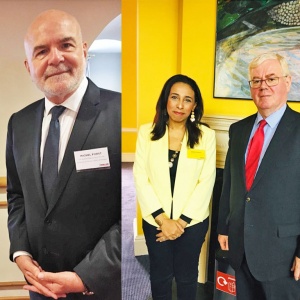
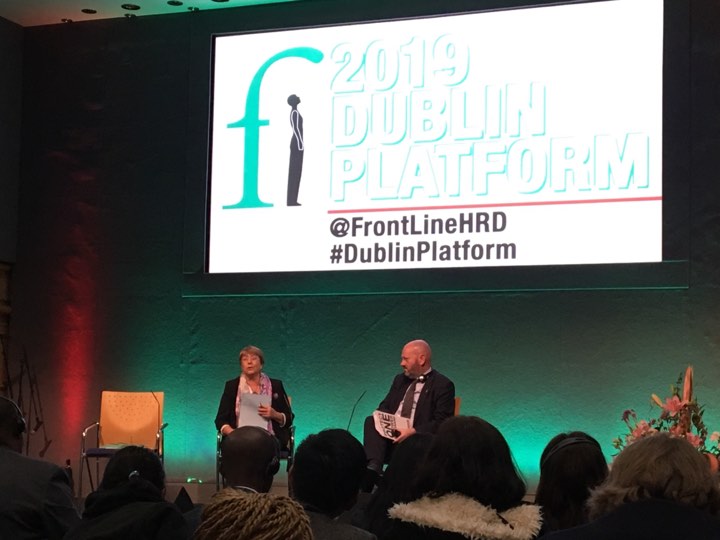
The Frontline Defenders Dublin Platform 2019 held in Ireland this month was a venue for IAWRT to connect with international Human Rights figures.

IAWRT Vice President, Abeer Saady, held meetings with the the EU Special Representative for Human Rights, Eamon Gilmore, and the UN Special Rapporteur on the situation of human rights defenders, Michel Forst.

“Unless impunity against defenders including women and women journalists is seriously addressed and ended, the cycle of violence and other human right violations against them will continue, endangering the realisation of human rights for all”.  Forst to Abeer Saady in their meeting.


Saady, who is also the IAWRT International Relations committee chair, discussed with Forst the threats women journalists receive around the world with attacks ranging from online harassment to assassinations, such as that of Maltese journalist, Daphne Galizia and Indian journalist Gauri Lankesh.

The common factor is the culture of impunity. and Forst said governments have a role to play. “Combating impunity is indispensable for the creation of safe environments for the defence of human rights, including journalists who reveal violations and corruption”

“States must not only develop a policy of zero tolerance towards attacks on human rights defenders but must also create the conditions for establishing a safe environment that is conducive to human rights defence efforts.“

Saady discussed the challenges IAWRT members are facing in countries with oppressive governments or where women journalists face risks in the practice of their profession, such as Afghanistan, Iraq, Philippines and Zimbabwe, as well as similar situations in Middle East, Iraq, Tunisia, Sudan and Palestine.

Gilmore said the European Union has to firm up its commitment to maintaining wonen’s rights,

“I think that rights that have been hard won over the course of the last century are now under pressure again. We are seeing a push back in relation to the rights of women and that is why I think they are particular issues that we need to prioritize in the EU.”

Saady informed both representatives about IAWRT efforts to push for gender equality in media workplaces, gender mainstreaming in media output, training on safety and combating online harassment.

Both representatives expressed interest in IAWRT efforts supporting gender mainstreaming, the safety of journalists and community radio.

Front Line Defenders – the international foundation for the protection of human rights defenders held the 2019 Dublin Platform for Human Rights Defenders at Risk from October 1-4.

Saady attended as a representative of IAWRT and spoke about challenges and pressing rights situations faced by IAWRT members and women journalists in general.

padmaja shaw

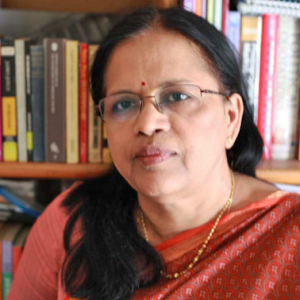
Veteran IAWRT Chapter India member Dr. Padmaja Shaw, has instituted a fellowship in IAWRT India.

The IAWRT-Shaw Memorial Fellowship is in memory of her late husband Rajendra Shaw.

Shaw was an alumni of India’s eminent film school – the Film and Television Institute of India (FTII) Pune (1975 batch) and a firm believer in affirmative action. 


The award was instituted on October 26, which was Rajendra’s birthday.


Rajendra Shaw worked his entire professional life in social sector organizations making communication materials, teaching and training people in visual and text documentation. He also mentored young people in photography,videography and video editing, in addition to writing in clear and simple language for text documentation.


“I wanted the scholarship in my late husband’s memory to continue this in some way, by helping a Dalit girl student get formal training in film-making techniques through any available/willing institute (state-run, commercial or colleges run by mission schools) to ensure that the student gets through and does come out with a portfolio that opens doors for meaningful work”  Padmaja observed.


Padmaja has given us Rs 5 lakhs to the IAWRT corpus and the  interest accrued every two years will be used towards a fellowship of an SC/ST candidate studying media/communications/film.


It will be in the form of an award so that for the student it becomes a matter of pride and accomplishment. There will be an innovative selection process and a two-member committee with Padmaja and one other IAWRT member will select the person for the award bi-annually.

Dont-read-the-comments-715x450

In Australia, there are calls for a united industry approach by media organisations to combat the prevalence of online harassment and abuse of women media workers.

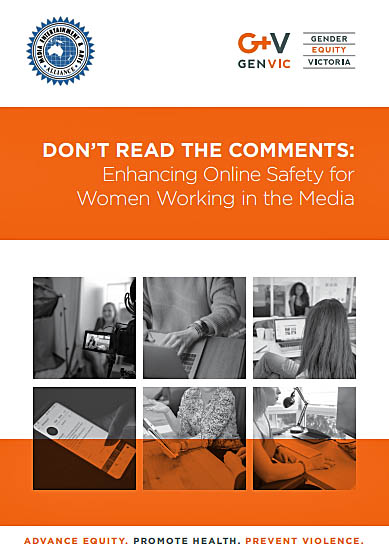
Two organisations, a journalists union and a women’s equity grouping have produced a report addressing online abuse of women journalists, which identifies the responsibility of media organisations for the online safety of in-house and freelance journalists.

The union is the the Media, Entertainment and Arts Alliance (MEAA) which has partnered with Gender Equity Victoria (GEN VIC) a peak organisation for equity, women’s health and the prevention of violence against women, based in the south eastern state of Victoria.

“While men and women are both trolled online, it is women who often receive abuse because of their gender, that takes the form of sexist and derogatory comments, through to serious accusations of physical harm such as death and rape threats.”  Kit McMahon, Chair of GEN VIC.

The Don’t Read the Comments: Enhancing Online Safety for Women Working in the Media report recommends that media organisations should begin treating gender-based abuse against women journalists on social media and websites as an issue of health and safety and take more responsibility for ensuring that women journalists are supported in the aftermath. .


A vast majority of journalists had experienced online harassment, trolling and stalking during the course of their work, but only 16% said they were aware of their workplace having existing policies to address online abuse.

Full report available here


The two groups called for for a united industry approach by media organisations to combat the prevalence of online harassment and abuse of women media workers noting that freelance journalists, who do not have the support structures provided by employers to their staff, are particularly vulnerable. 

The report recommendations are:


  • A whole-of-organisation approach to address systemic and structural sexism in the workplace.
  • Training on gender, implicit bias and bystander intervention for all staff in a media organisation.
  • Treating gender-based abuse against women journalists on social media and websites as an issue of workplace health and safety.
  • Moderation guidelines and training that explicitly address gendered and other identity-based abuse as a subset of abuse that requires a strong response from the organisation.
  • Requiring audience members to complete a simple comprehension quiz before they are permitted to comment.
  • Requiring commissioning editors to provide specific support for freelance journalists even after the story has been published and invoices paid


Adam Portelli, MEAA’s Victoria & Tasmania Regional Director, says women journalists should not feel that they cannot safely participate in online platforms, or self-censor to avoid abuse. “In the modern publishing age, journalists are expected to have a presence on multiple digital platforms, and it is unacceptable that they feel unsafe because of bullies, trolls and stalkers,” 


“For better or worse, social media and other online platforms are part of the modern journalist’s workplace, and online abuse and harassment must be treated as a workplace health and safety issue.” 


Adapted from  MEAA and Genvic

Four IAWRT members have accepted an invitation to participate in a conference focusing on gender in media education in Jakarta.

The gathering is being organized jointly by the Journalism and Media International Center (JMIC), 

JMIC is a part of the Department of Journalism studies at the Oslo Metropolitan University (OsloMet) in Norway, and Universitas Indonesia.

The topic is teaching journalism and media studies and will be held from October 28-29 at the Margo Hotel in Depok, within the Jakarta metropolitan area in Indonesia. 

JMIC has developed cooperation projects with several universities around the world, on topics such as safety training for journalists, press freedom, and photojournalism.

One of the sessions of the conference is on The impact of social media on gender and journalism, where IAWRT President Violet Gonda will speak on IAWRT’s transnational project on protecting women working in the media from online harassment and cyber violence: research and implementation.’

 IAWRT Vice President Abeer Saady will speak on ‘The influence of women journalists’ gender on their safety decisions in IS (ISIS) controlled regions: across border study conducted with journalists covering conflicts in Syria, Iraq and Libya’, This is part of a session entitled Gender-based media research: How to move forward and work together?

Saady will also speak in the session on Diversity, marginalization and intersections about ‘Measuring the impact of training local trainers on safety manuals for women journalists.’ Conference coordinator and IAWRT member, Oona Solberg, will also speak on the topic ‘Gendered Photojournalism?’ in this session.

Another session is on How to integrate gender perspectives in journalistic and academic settings’ where IAWRT Philippines Vice President Lynda Garcia will speak on ‘The Philippine experience in mainstreaming gender in the higher education institutions.’ IAWRT Afghanistan Chapter head Najiba Ayubi will speak on ‘Teaching gender and media in Afghanistan.’


Book launch

Transnational Othering – Global Diversities, Media Extremism and Free Expression will be launched during the conference. Contributors include Ade Armando, Andina Dwifatma, Lestari Nurajati, Abeer Saady and Elisabeth Eide. Eide also served as the book’s editor.

The anthology, written in English and published by Nordicom, addresses complex interconnected issues, such as the rise of extremism and terrorism, diversity and minority rights, as well as the situation for freedom of expression in eight different countries, most of them with a Muslim majority population. It is Download chapters or purchase here


JMIC and IAWRT

As a pilot project, JMIC is now including IAWRT in some of its activities, this conference being the first.

Another upcoming cooperation is the Arabic translation of IAWRT’s safety training book ‘WHAT IF,’ which is due to be published by the end of the year.

This program is financed by the Norwegian Ministry of Foreign affairs and restricted to partner countries in the global south.

The background for this partnership between JMIC and OsloMet is the fact that JMIC’s leader, Professor Elisabeth Eide, has always had an interest in women in media throughout her substantial career in research, teaching and in her published works.

The JMIC coordinator Oona Solberg has been an IAWRT member for 20 years, and has held the position of secretary as well as accountant of the international board.

This is also a juncture where JMIC will include active journalists, as well as researchers, in their conferences. 


Conference partners:

  • Department of Journalism and Media Studies/Journalism and Media International Center (JMIC) at Oslo Metropolitan University, Norway
  • International Association of Women in Radio and Television (IAWRT)
  • Department of Communication, Faculty of Social and Political Sciences at Universitas Indonesia
  • Communication Research Center, Institute of Social and Political Research and Development (LPPSP FISIP) Universitas Indonesia
  • Gender and Sexuality Research Center, Institute of Social and Political Research and Development (LPPSP FISIP) Universitas Indonesia

Depok, Indonesia, October 28-30, 2019. 

Three day event on gender teaching at the tertiary level, and examining online violence against women in the Asian region.

The Department of Journalism and Media Studies/Journalism and Media International Center (JMIC) at Oslo Metropolitan University, Norway and the Department of Communication, Faculty of Social and Political Sciences at Universitas Indonesia, have partnered with IAWRT and other research centres in the University of Indonesia to put on the three day event.

IAWRT will be represented by President Violet Gonda, Vice President Abeer Saady, Lynda Garcia Vice President of IAWRT-Philippines and  Najiba Ayoubi, the head of the Afghanistan Chapter. The gathering will include the launch of the book Transnational Othering – Global Diversities, Media Extremism and Free Expression.  Download chapters or purchase here.

AFF ends

16th IAWRT Asian Women’s Film Festival, 2020

Surabhi Sharma and Priya Thuvassery

The 16th IAWRT Asian Women’s Film Festival will be held in New Delhi from 4-7 March 2020

Curators are now beginng the selection of about 700 enties to the highly successful non-competitive festival which brings together the works of Asian women directors (resident in or outside of Asia) in a range of genres – animation, documentary, experimental, short fiction and television reportage. The India chapter of the International Association of Women in Radio and Television has been organizing a film festival to celebrate International Women’s Day since 2005. 

IAWRT India in partnership with India International Centre holds the festival at the IIC, New Delhi every year. This years directors are Surabhi Sharma, an award winning documentary filmmaker presently based at the New York University in UAE, and Priya Thuvassery, an award winning documentary filmmaker in India’s prime television channel, New Delhi Television (NDTV).

In the 16th edition of the festival, alongside the general program there will be curated sections focusing on women directors from countries within the Middle East, the works and journeys of women photographers and a section across genres curated around the theme of  ‘Her upside down gaze’. Some of the questions that this curated section seeks to address are: What are the myriad ways in which women filmmakers are re-imagining the craft of filmmaking? Does our experimentation with film form reflect shared concerns, connect similar strategies, define a distinct vision of both our subjects and ourselves? see  below for the directors concept note.

The 15th edition of the festival received a similar number of entries from 37 countries. We screened 51 films and had a curated section titled Soundphiles that covered a range of sonic genres.

Over the years the festival has attracted diverse audiences enabling vibrant discussions. Sections of the festival have traveled to various Indian cities and International festivals in the past years.

For further information https://iawrtindia.blogspot.com/ enquiries at [email protected]