Aug 23 narrowcast with Lumad youth

Ongoing Man-Made Crisis. By Marvie Matura

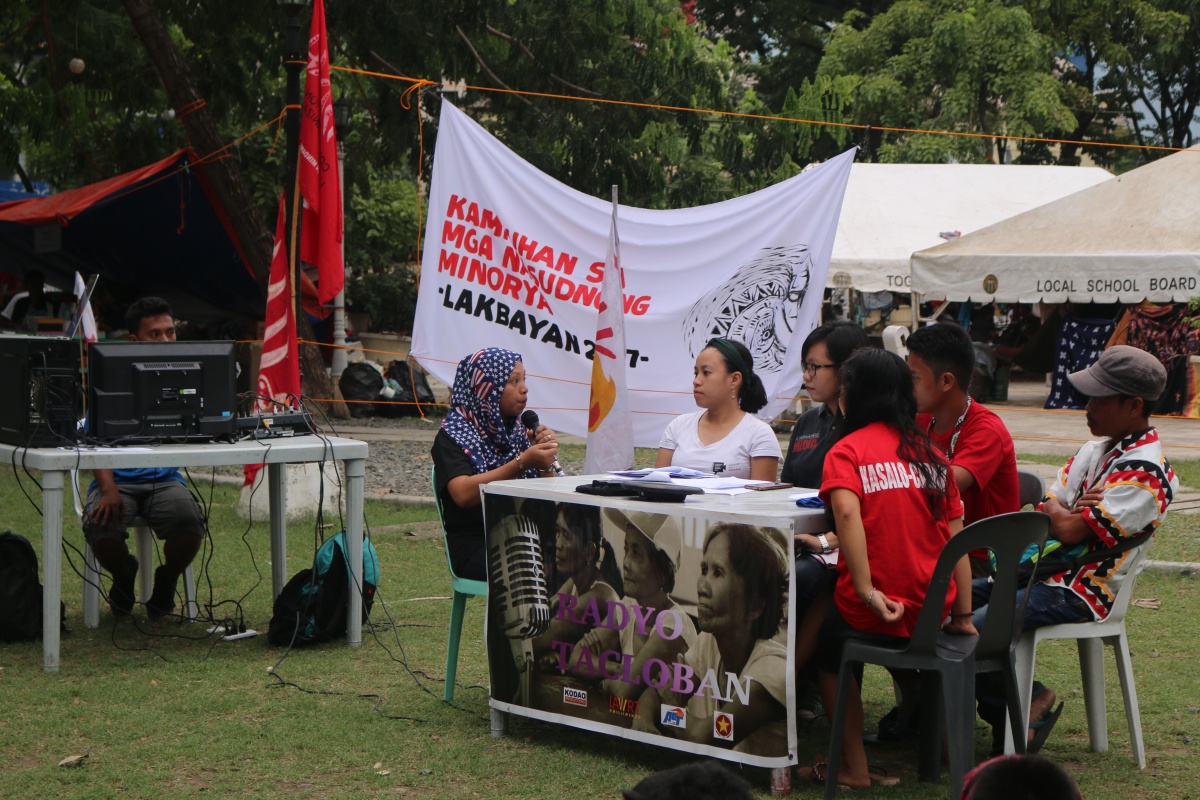
A special narrowcast episode of the Radyo Tacloban Project in Cebu City has discussed the situation of Muslims and indigenous people in Mindanao 

who have been affected by the ongoing siege in Marawi City and the subsequent declaration of martial law over the whole island of Mindanao.

Settie Rahma Harim, who was displaced by the Marawi siege, told the program she and her family fled from their home when military airstrikes began.  She stayed in an evacuation center despite the dismal conditions and was forced to send her children to live with relatives. Because of the war, Rahma Harim lost her job and had to rely on donations from kind-hearted individuals and relatives, to survive each day.

“I only brought with me few clothes as I thought the war would end soon. I was wrong,” she said.

The war in Marawi City started in May after a military-initiated operation against Abu Sayyaf leader Isnilon Hapilon, following military reports that he was in the city (Hapilon is a Filipino Islamist militant affiliated with ISIS who is also known as ‘Abu Abdullah the Filipino’). Since then, firefights between the military and the ISIS-linked Maute group have been ongoing, with the Philippine Armed Forces launching airstrikes to clear the city of insurgents.

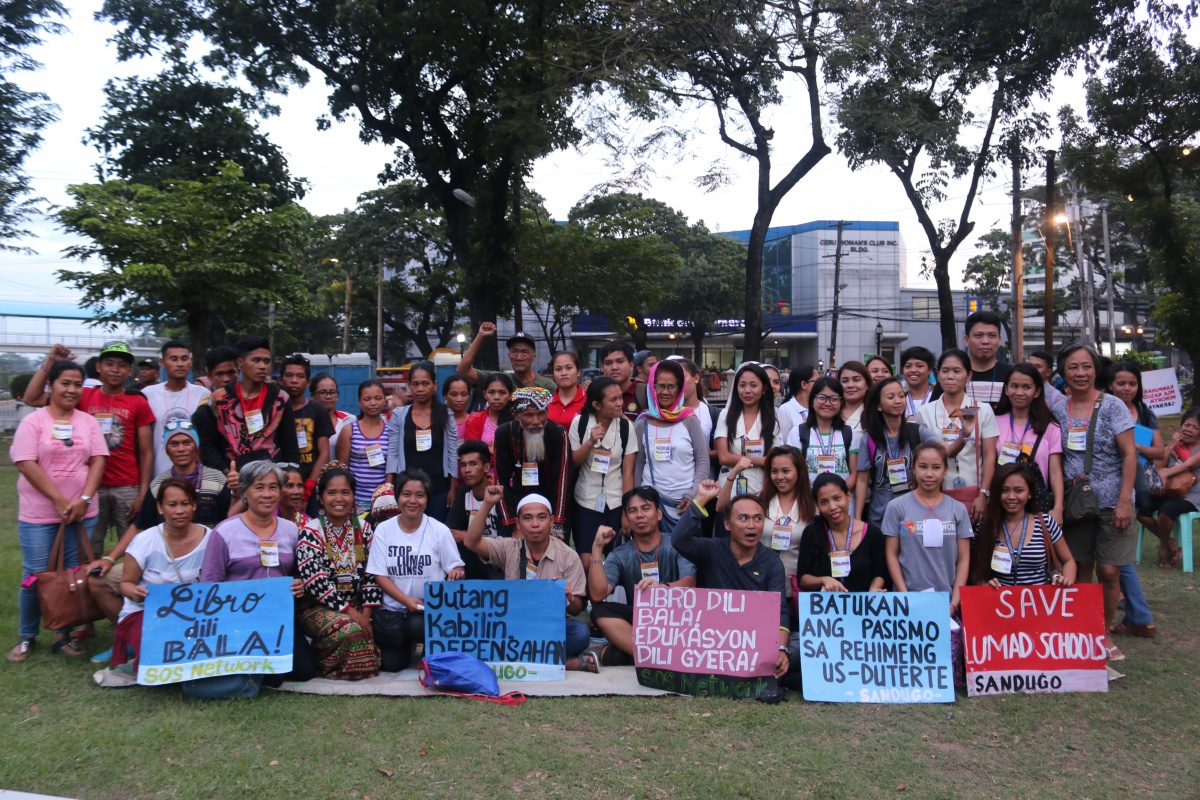
Rahma Harim is one of the delegates to the Lakbayan 2017 (People’s Journey) a nationwide four month-long event, organized by the national minorities (indigenous, Muslim and other marginalized ethnolinguistic groups) demand for an end to the militarization of their communities.  From Mindanao, the delegates traveled to Cebu City in central Philippines for a stop-over before heading to the capital Manila.

Fellow radio program resource persons Sarry Campos, Esel Libora and Julito Ofacan, are Lumad people, a southern Philippine native ethnic group. They talked about their resistance to big mining operations on their ancestral lands and accused giant mining companies of employing paramilitary forces that killed many Lumad who opposed them.

Campos is a student of a school for indigenous youth in the CARAGA region in the north-east of Mindanao, called the Alternative Learning Center for Agricultural and Livelihood Development (ALCADEV). She said their school and teachers are being accused of being rebels and said that there have been threats to bomb their school.

She recalled that on September 1, 2015, their executive director was brutally killed inside their school while their community leader was shot dead by the paramilitary in front of a crowd. See Amnesty International report.

The three also spoke against President Rodrigo Duterte’s declaration of martial law. The radio program speakers demanded that the Duterte government end its aerial bombings of civilian communities and lift martial law in Mindanao.  They also called for the respect of their right to self-determination as indigenous peoples.

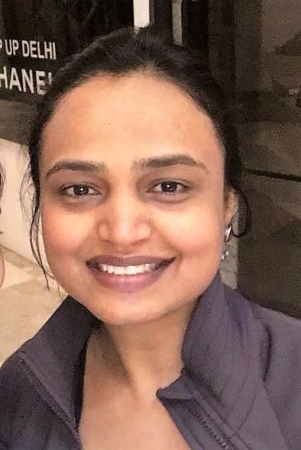
Photos of narrowcast with Lumads and Moro who traveled from Mindinao, by Jola Diones Mamangun.

Radyo Tacloban is a community radio project supported by the International Association of Women in Radio and Television in cooperation with Kodao Productions and Central Visayas Farmers Development, Inc. (FARDEC).


iawrt blank square_resize-1

IAWRT 37th Biennial beckons you

by Geeta Sahai

The International Association of Women in Radio and Television (IAWRT) in collaboration with IAWRT Philippines is organising its 37th Biennial Conference. It is to be held in Quezon City, The Philippines, from 9-11 November 2017.

The conference venue is Microtel by Wyndham – UP Technohub in Quezon City.

This year’s Biennial will feature the launch of IAWRT’s first Safety Training Handbook, and screenings showcasing the shortlisted entries of the IAWRT Awards of Excellence, including time for showing IAWRT members’ productions.

The conference will bring together women journalists working in electronic and print media and documentary film makers from all over the world to initiate dialogue and share experiences in pursuance of IAWRT’s ongoing work to strengthen women’s voices in and through the media. Over 100 women media professionals are expected to attend.

This year’s Biennial theme is Broadcasting and Social Justice: Women in the Media on Conflict and Crisis.  The three-day conference includes plenary sessions, workshops, film screenings, cultural shows and an excursion to the nearby historical places. Some of the important issues which would be discussed are – challenges for Filipino women journalists, women covering terrorism, women in the media braving Disasters.

We will have an all-day Members’ meeting to discuss organisational developmental issues, the new evaluation report, chapter reports, and election reforms.

It would be nice to see you at the Biennial.  

Welcome to the world of amazing professionals, stimulating discussions and motivating environments.

Download the Registration form below. 

spnia

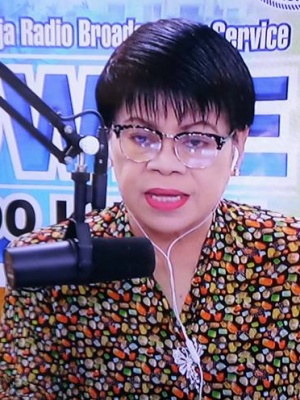
Host of gender-sensitive Tele-radio, DWNE 900, Nueva Ecija

and Information Officer, Office of the Provincial Governor, Province of Nueva Ecija; Manila, Philippines.

What type of projects do you do? 

  •  Produce and host a gender-sensitive radio or tele-radio program (Simulcast radio and television transmission)

  • Accept invitations to be a resource speaker in gender-sensitivity seminars organized by national government agencies such as Government Insurance system (GSIS); Department of Trade and Industry (DTI); Bangko Sentral ng Pilipinas (BSP); 7th Infantry Division, Philippine Army based in Fort Magsaysay, Nueva Ecija

  • Organize gender-sensitivity training seminars and serve as a speaker

Why did this sort work interest you, and how did you get started?

  • After earning my bachelor’s degree in mass communication in 1975, three years after martial law was declared by then dictator President Ferdinand Edralin Marcos, I started teaching mass communication subjects. I was invited to be a disc jockey in the first all-woman FM radio station, DWDM 95.5FM.  Later I transferred to a radio program on an AM station to work as a reporter, news writer, newscaster, news coordinator and music librarian.

  • Eventually, I learned how to produce and host a public affairs radio program as a block timer (independent radio program producer and host, buying a time slot in a radio station through sponsorship). Initially, the president of an alliance of trade workers, who used to frequent my regular station-produced program, invested on my new block time program which I entitled Open Forum.  I got the chance to network with individuals and mass organizations belonging to the massive people’s movement against the dictatorship. The People Power Revolution in February 1986 ensued and ousted President Ferdinand Marcos. In a conjugal dictatorship with his wife, then First Lady Imelda Romualdez Marcos, the Marcoses had plundered the country’s wealth, caused severe environmental degradation and the destruction of thousands of human lives, individuals and Filipino families alike, through their gross 20-year rule in the Philippines.

  • The People Power Revolution became known as the 1986 EDSA Revolution as it occurred along the 54-kilometer stretch of Epifanio Delos Santos Avenue or EDSA in Metro Manila. The unprecedented event, which gained international prominence, triggered me to commit my radio production to the people’s issues. Most interestingly, towards 1989, I got engaged with the women’s movement. 

  • In 1989, then Representative Hon. Anna Dominique “Nikki” Coseteng, who later became a Senator, recommended me to her colleagues in the Women’s Media Circle to host a radio program being conceptualized for women, by women and about women. In April 1989, I started hosting RADYO WOMANWATCH, the first feminist radio program, at least in Metro Manila.  Sen. Nikki Coseteng hosted WOMANWATCH on PTV4, a block time TV show in a government-run television station while I became her counterpart in radio. RADYO WOMANWATCH was heard over a number of private radio stations. Consequently, a number of women’s groups approached me to train them in radio hosting. The late Senator Leticia Ramos Shahani hired me to co-host in her lunchtime program over a top-ranking radio/TV network.

  • In 1990, I was invited by an all-male Rotary Club of Cubao EDSA, presided then by a former Assemblyman, Atty. Roger Quiambao, to organize the first all women Rotary Club in Rotary International District 3780, Quezon City. I was reluctant, but after nine months of collective work with other professional women, the second all-woman Rotary Club in the Philippines was recognized. Unanimously agreed by the members, I named it the Rotary Club of Prima Vida Cubao; Prima Vida meaning “first life”. It was chartered on May 20, 1991 with me as Charter President. I was later appointed as a District Officer, most distinguished for me, was the Chair of the District Committee on Women Affairs. We were honored by different awards and citations.

  • Inevitably, my contract with Women’s Media Circle ended in 1995.  I moved on as a freelance broadcast journalist.

  • In 1996, I put up WOMANTOUCH MEDIA, had it registered at the Philippine Stock and Exchange Commission (SEC) as a non-profit, non-stock association and launched “WOMANTOUCH RADYO” a gender-sensitive radio production. 

  • In the same year, 1996, the Rotary International media team invited me to the Rotary International Convention in Singapore, to speak on Rotary and Children’s Issues. To maximize my five-day stay in Singapore, I took the opportunity to produce a radio documentary about the plight of Filipino women overseas workers, with the help of an organization group of Filipino OFWs in Singapore. The project was sparked by the execution of a Filipina domestic helper, Flor Contemplacion in Singapore. Written in Filipino by me, assisted by my colleagues in Womantouch Media, it was recorded, edited and aired in a series through my own self-sustaining radio program WOMANTOUCH RADYO and heard over a government-run radio station connected with the Philippine Broadcasting Service (PBS).

  • In 2000, I was hired as Project Manager by Isis International to help organize a seminar-workshop for women broadcasters in Asia and the Pacific on digital radio broadcast and editing, held in Bangkok, Thailand.

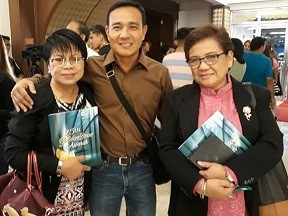
  • In 2001, after then Philippine President Joseph Estrada was ousted by the second EDSA People Power Revolution, Kodao Productions found me and took me in to host a block time radio production which I entitled “NGAYON NA BAYAN! (People, Unite Now!)” It gained a considerable following and an organized group of listeners. In 2002, “Ngayon Na, Bayan!” received the 12th KBP Golden Dove Award for the Best Public Affairs Radio Program. KBP is Kapisanan ng mga Brodkaster ng Pilipinas (KBP). (pic right: Sonia M. Capio (left) at the Star Theatre, Cultural Center of the Philippines, during the 25th KPB Golden Dove Awards.

  • Coincidentally, on the same occasion, I was recognized as one of the finalists for Best Public Affairs Radio Program Host for hosting Womantouch Radio. A series of recognitions by the Catholic Mass Media Awards followed. However, “Ngayon na, Bayan!” lasted only until February 2006.  Our program was the first casualty of Proclamation 1017 imposed by then President Gloria Macapagal Arroyo declaring a state of national emergency, quite similar to the 1972 martial law of the deposed dictator Marcos. Earlier, despite a number of warnings from Malacanang Palace, (the official Presidential residence/office) we were dauntless in our investigative broadcasts. This was in spite of the propagation of “Know Your Enemy” readings from the Armed Forces of the Philippines, which demonized some media practitioners and institutions that were critical of the incumbent government. Malacanang Palace then threatened our carrying radio station, DZRJ. Thus, we were put off the air.

  • In July 2007, I was offered a teaching job in a community college run by the provincial government of Nueva Ecija. Thus, from Metro Manila where I worked almost half of my lifetime, I moved to Nueva Ecija, the largest province among the seven provinces in Region 3 or Central Luzon. I became the confidante of the college president. As a college extension project, a gender-responsive public affairs program was conceptualized and called it MAGTULUNGAN TAYO! (Unite and Work Together, Now!) Eventually, the provincial government of Nueva Ecija took me in as a Consultant of the Governor on Broadcast and Gender Concerns. In 2011 I was given a permanent position.

  • Since 2008, the MAGTULUNGAN TAYO! radio program, produced by Gender Voice Promotions has been self-sustaining.  It is continuously aired through DWNE 900, the provincial radio station.  We have been networking with and assisting national government agencies and local government units in Nueva Ecija without a fee. However, a number of them sponsor media projects and the gender-sensitive training seminars we organize through Gender Voice Promotions. Gender Voice Promotions also coordinates with mass media organizations which I serve as Chair, like the National Union of Journalists of the Philippines (NUJP) Nueva Ecija Chapter; Nueva Ecija-Aurora Energy Press Corps (NE-AEPC) organized by the National Grid Corporation of the Philippines, Region 3; and the Central Luzon Media Association (CLMA) Nueva Ecija Chapter in which I serve as Executive Vice President.

What part of this job do you personally find most satisfying? Most challenging?

  • Personally, what is most satisfying for me is when individuals, organizations, NGAs and LGAs seek my assistance to participate as a resource speaker in their GAD Seminars and to promote their programs, activities and projects.

  • They subsidize all my travel accommodation costs just to ensure that I will be with them. Quite satisfying indeed are recognitions through citations, plaques and tokens.

  • In previous years, it was most challenging to address the indifference of government officials and even a number of female and male media persons about the significance of gender and development.

  • The foremost challenge was being able to feature topics and guests from non-government organizations and women’s groups to provide them a broadcast slot in my radio production to speak out against government policies and actions which did not truly serve the people’s welfare, and providing them a space to suggest rational recommendations. 

What do you like and not like about working in this industry?

  • What I like about working in the mass media industry is the continuing education for me. I do research almost every day; monitor news and commentaries, and read documents related to pressing issues. This gives me the chance to equip myself with necessary background and information to be confident in radio interviews, in press conferences and ambush interviews.

  • Likewise, by attending seminars, forums and roundtable discussions organized by mass organizations, women and gender advocates and the education sector, I gain opportunities to be part of the solution.

  • What I don’t like most is when some people in the mass media, private institutions, national government agencies and local government units trivialize even basic gender and development concepts. It is quite disappointing that some media leaders and top government officials, who are supposed to take the lead in mainstreaming the gender and development program, do not exert efforts to understand GAD, to use such to improve their work style and to serve better.

My strongest assets/skills, areas of knowledge, personality traits and values are….

  • Thank God for all the blessings, opportunities and the gift in broadcasting and GAD advocacy.

  • Modesty aside, I strongly believe that I have passion and considerable expertise in conceptualizing and hosting gender-sensitive radio and TV productions.  I certainly believe that God has reasons for me to go on living soundly, surviving two surgical operations on uterine cancer and metastatic lung cancer. The foremost reason for me is to continue my commitment as a gender-sensitive broadcaster and educator.

Has IAWRT’s network of media women around the world helped or inspired you?

·         This is my first time to be involved with the IAWRT Philippines.  I intend first to inspire the group, and then be inspired by every member and the entire group consequently.

What are your long-term goals?

  • I’m now in my senior years but have not lost my heart’s desire to educate and inspire people and society, for the country.

  • My long-term goal is to establish a broadcast and gender studies center in Nueva Ecija – educating women and men, young and older ones alike, on personality development, progressive leadership values, and gender-sensitive broadcast work through gender and development (GAD) capacity enhancement seminar-workshops.

What special advice do you have for young women seeking to qualify for this type of work?

  • My first advice for young women seeking to work in mass media is this: Believe in your dreams; small people will ignore them and those who are really great will help you achieve your goals.

Do you have any special words of warning, or encouragement, because of your experience?

  • Women media persons deserve respect.  Whether you are neophyte in media work or more experienced, no one has any right to sexually harass you or to humiliate you. Some will dampen your spirit because they feel you are a threat to them.  You can make them treat you well, if you respect yourself.

links.  

gauri_lankesh_grafiti_b750x500_fb

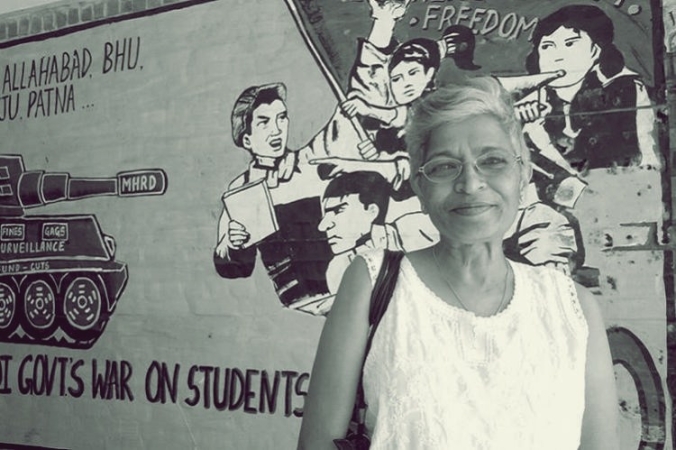
The murder of journalist & activist, Gauri Lankesh at her home in Bengaluru, (Bangalore) the capital of the southern Indian state of Karnata, has again put the spotlight on the saftey of Indian journalists. The shooting of the well respected editor and critic of right-wing Hindu extremism has been condemned widely by media groups, leading to a number of protest demonstrations and global condemnation from groups including Amnesty International, s, the Comittee to Protect Journalists, the International Federation of Journalists and Reporters without Borders (RSF).

Daniel Bastard, the head of RSF’s Asia-Pacific desk, said “We take note of the determination of the local authorities to investigate this murder and we encourage them not to neglect the possibility of a political link. Gauri Lankesh was on several occasions the target of the ruling Hindu nationalists and their supporters, because she categorically refused to submit to the self-censorship that is eating away at India’s media.”

From India, Monobina Gupta writes: If the Indian Media Did Its Job, Gauri Lankesh Wouldn’t Have Been Killed for Doing Hers 

It may be naive to consider the assassination of  the feisty editor of the weekly Gauri Lankesh Patrike, a random act of violence. Politicians can’t simply take refuge with the alibi that Lankesh was killed by ‘unknown gunmen’. Especially not at a time when such acts have become the norm and are no longer aberrations in daily life. Her murder raises important questions about the culture of fear the Indian state promotes through its selective silences and refusal to name groups that use violence – often to muzzle dissenters.

Larger issues related to dissent, press freedom and the atmosphere of intolerance proliferating throughout the country every day cannot be overlooked or dismissed in accounting for what has happened. There is no getting away from this reality. Dodging the truth only emboldens those who want us to ignore the facts on the ground. There is no solace to be drawn from inquiry commissions; and no point in waiting for investigations to take their own course. Far too often, bureaucratic procedure stalls political anger, effectively ‘disappearing’ cases into a labyrinth of files and inconclusive inquiries which drag on endlessly. Invoking procedure is an effective way of shutting down uncomfortable questions.

After all, what answers have we got so long after the murders of M.M. Kalburgi, Govind Pansare and Narendra Dabholkar?* Are we not still looking for their killers? “The murder of Lankesh has eerie resemblances with those of scholars Kalburgi, Pansare and Dabholkar. All the three rationalists were assassinated in a similar fashion with the Crime Investigation Department revealing that the weapon they were shot with was also the same. The Bombay high court had also on August this year, observed that the modus operandi in the murder of Dabholkar and Pansare were similar and that it was indeed a ‘well planned’ act,” Outlook reports.

Over the last three-and-a-half years, we have witnessed a string of murderous mobs – euphemistically described as ‘non-state actors’ – operating as vigilantes in the name of cow protection, nationalism and a whole range of issues under the garb of hurt sentiments. These mobs have constantly treaded on and disregarded the rights of citizens. And in their face, our outrage as a collective body has been sporadic and muted at best.

It must be repeated that interrogating dominant power structures, repressive regimes and cultures of fear and intolerance constitutes the soul of journalism. Lankesh’s work stands testimony to this face. Till her last day she wrote about ‘uncomfortable’ issues, such as the plight of Rohingya Muslims who have failed to get an assurance from the Narendra Modi government that they will not be deported to Myanmar – to likely imprisonment or death – before their court hearing in India is over. She spoke out on gay rights, and on the deaths of children in a Gorakhpur hospital.

Lankesh’s assassination at the doorstep of her home brings to mind the murder of another woman journalist thousands of miles away from India. Eleven years ago, on October 7, 2006, the Russian writer and human rights activist Anna Politkovskaya, a journalist with the Russian newspaper Novaya Gazeta, was murdered in the lobby of her apartment building.

A staunch critic of the Putin government, Politkovskaya wrote extensively on controversial subjects like the Beslan school siege, and the Chechen war, which the government didn’t want to talk about. It is believed her murder was carried out by contract. “No other reporter has been assigned Anna Politkovskaya’s desk in Novaya Gazeta’s newsroom. It remains as a memorial, alongside her photograph and those of other murdered journalists at the newspaper, and as a reminder of the danger of the work” according to a report in The Guardian. And her newspaper still continues to practice independent journalism, ceaselessly interrogating the government.

In an interview, Politkovskaya had said, “People sometimes pay with their lives for saying aloud what they think. In fact, one can even get killed for giving me information. I am not the only one in danger.”

A day after another journalist who spoke against power has been murdered, the best and most urgent tribute we can pay to her memory is to ask: What will it take for the Indian media to start fearlessly doing its job day after day instead of mourning a handful of brave colleagues after it’s too late? 

Monobina Gupta’s article reprinted with permission. Originally published September 6 2017 on the Wire an independent, not-for-profit website operating out of New Delhi, India. 

The Producer of Velvet Revolution the IAWRT’s documentary on women journalist facing danger, Nupur Basu, has also written an article paying tribute to her friend and colleague.

* scholars and academics who were critical of right-wing Hindu agendas and argued for a rational approach to superstitions

long doco image rs

IAWRT is seeking member applications for the position of Executive Producer for the next IAWRT long documentary.

The organisation has produced three documentaries consisting of short profiles from different countries on a theme related to women, that are fused together into an international production – Velvet Revolution (2016), Reflecting her (2015) and Hands on: Women : Climate : Change (2014).

For this production, the board has proposed the theme Women covering conflict: the invisible stories.

The President of the IAWRT International Board, Gunilla Ivarsson says the project would attempt to make such invisible stories and the process of reporting them, relevant to a broad international audience; it invites documentary makers to go beyond the immediate in conflict reporting. She says women filmmakers often get access to different stories than men do.

“The victims of conflict are not only those killed: they are also the mothers who could not get to the clinic; they are the unborn child and the long-term consequences of conflicts – the orphan who will not get an education, support or love. We also know that domestic violence is higher in times of conflict.”

The IAWRT is keen to experiment with a film format that would enhance this content to its full potential. Producers with proven track records in leading documentary projects are invited to submit applications for this position.

Applicants are asked for a detailed proposal and treatment note, but will ultimately be be part of a collaborative process to finalize the theme, choose the format, identify the local directors/producers. She will lead the project untill completion.

The documentary is due to be submitted by 1st May 2018.

The budget for the entire project currently stands at USD 28,000. The producer’s proposal should include:

● A letter of intent expressing her commitment to the theme

●  the proposed treatment

● A CV and show reel

● A detailed budget

Deadline for proposals is September 15th, 2017.

Please note the funding from “FRITT ORD” ( Free Speech) in Norway, has no geographical restrictions on the nationality of members who can apply. (i.e members from the global North are eligable).

contact: [email protected].


The 14th IAWRT Asian Women’s Film Festival is now recieving entries for the Festival which will will be held from 5-7th March, 2018 in New Delhi. To mark International Women’s Day, IAWRT India organises this film festival every year. 

Closing date for receipt of entries  31st Oct, 2017. Details and entry forms attached below. Online downloadable link

iawrt blank square_resize-1

Now includes fundraising skills for media projects

The IAWRT President Gunilla Ivarsson has announced an extended deadline​ ​to ​appy ​for a 2017 IAWRT​ ​/FOKUS​ ​Scholarship​ ​for​ ​Studies​.

Apply by​ ​September​ ​10th,​ ​2017​.  $US 3,800  is available to divided amongst applicants.

Any inquiries to [email protected].

The criteria are:
1. You must have been a paying member of IAWRT for the last 2 years
2. The area of study should benefit the activities of IAWRT International and/or the local IAWRT Chapter and women in media.
3. Area of study can be for professional development to help the applicant to maintain and strengthen their journalistic skills, or for training on media leadership, fundraising for media projects and management skills.
4. Financial support can be used for professional development training and studies only. (Not for travel and accommodation costs)
5. The member must provide documentation of acceptance from the approved institution.
6. The beneficiaries shall report on the use of their scholarship and study progress both in the middle of the course and upon completing of the course. Proof of completion from the learning
institution/faculty must be provided. If failing to report, IAWRT International will demand the scholarship money back, to be returned through appropriate means.
6. IAWRT International shall be informed of any other scholarship that the recipients are given.
7. Send your application or queries to the Secretariat, [email protected].

Further details below.

The sixth Nepal Africa Film Festival, is being held from September 18 to  20, at the Russian Center of Science and Culture in Kathmandu. The festival is directed by long term IAWRT member, Dr. Manju Mishra, and the College of Journalism and Mass Communication. 

The Festival seeks to address the need for a platform that provides an unbiased and integrated representation of Africa’s diverse cultures and the way in which the continent is dealing with change. Details at www.nepalafricafilmfestival.com.np 

iawrt blank square_resize-1

Nominations open until August 9

2017 is election time for the 7 positions on the IAWRT International Board.

The Nominating Committee is now receiving nominations for President, Vice President, Secretary, Treasurer and three members-at-large. Elections will be held at the members meeting at the Biennial conference being held from 9 -11 November 2017 in the Philippines.

Candidates must have been an active dues-paying member for no less than 2 years. Email nominations to Racheal Nakitare, head of the committee on [email protected] and copy (cc) to committee members: Valerie Lew – [email protected] Nupur Basu – [email protected] Khedija Lemkechier – [email protected] and Solveig Helvik – [email protected].

The Nominating Committee has the responsibility of preparing a balanced proposal of suitable candidates for the 2017-2019 term of the international board . That proposal, along with all nominations, will be presented and explained at the members meeting at the Philippines conference. It will also be emailed to members beforehand.

Additional nominations can be made from the floor during the membership meeting. Elections will be conducted according to IAWRT’s current statutes.

Contact [email protected] if you need to renew membership. NOMINATION FORM attached below.

The deadline for sending this nomination form is 20 August 2017. 

arshiya2

Inspiring Creativity in a Cross-Cultural Global Setting

In 2017, the IAWRT awards for excellence, will be presented in the Philippines where they began, when the Biennial returns to that country, hosted by a renewed local chapter.

Fittingly, the 2017 Awards have been revamped to better reflect the rapidly changing media world, with revamped categories,

The new coordinator,  Arshiya Ahsan (pictured) is working on a broader online media presence starting with an IAWRT Awards Facebook Page and a streamlined online submission  process. IAWRT International Documentary Awards 2017 now proudly accepts entries via FilmFreeway.com, the world’s best online submission platform.

Media and women in changing times

The IAWRT Awards have been integral to the IAWRT’s  international biennial conferences since 1994, when Mette Janson, from NRK, Norway, and Christina Ruhnbro, from Swedish Radio, planned and coordinated the first TV awards.

Arshiya has a hard act to follow after more than a decade’s work by the indefatigable Gerd Inger Polden, , from Norway, (pictured right) She worked on the awards from 2003 and officially took as coordinator in 2005 after the death of Mette Jansen.
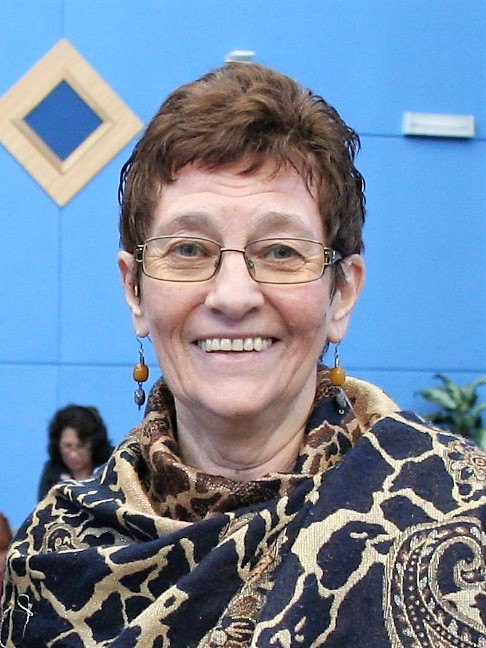
The Awards had grown to include radio documentaries, and during Gerd Inger’s 12 years, as the pace of change to the media landscape and platforms escalated, they were modernized again by including two more categories, eb video and web audio documentaries.

IAWRT President Gunilla Ivarsson says Gerd Inger coordinated the IAWRT Awards almost alone, and often in combination with other IAWRT responsibilities. “She has generously shared her experiences, dos and don´ts and given constructive feedback. Thanks a lot Gerd Inger, it is thanks to you, who took up the gloves after Mettes death and had the energy to go on and on, that we today have a solid ground to stand on.”

Gerd Inger Polden says it was the most rewarding and inspiring work she did for IAWRT. “I want to  thank all the jury members for their enthusiasm, competence and hard work. Together we have made the jury work capacity building” she said “I thank IAWRT for 12 years of gratifying work”.

This capacity building will continue with jury presentations and discussion at the 2017 Biennial, which will be shared on more platforms.

New Coordinator, New Categories

Arshiya Ashan is one of the founding members of the IAWRT-USA chapter and a communications professional in the not-for-profit sector. She says she’s excited about the opportunity to build the next phase of the IAWRT Awards.

“I feel humbled to take on this role from Gerd Inger, who has been truly inspirational in her work, and instrumental in shaping the awards in the last decade.”

From 2017, rather than dividing productions into formats such as radio or television or online, the awards are based on three new categories to reflect the constant merging and emerging of media forms. The categories are; Social Impact, Innovation, and Emerging Talent.
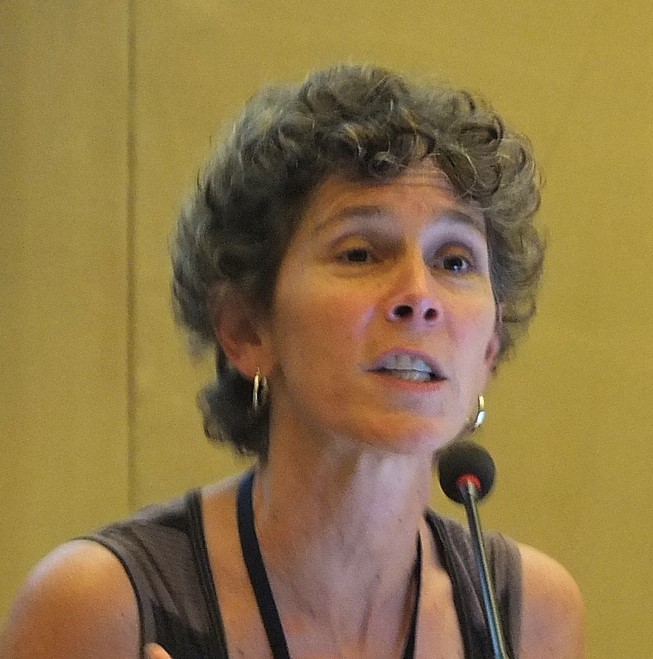
One IAWRT awards committee member, Liz Miller says the intention of the new categories is to try and break down traditional barriers between media genres, “… and open up more dialogue amongst each other about new directions in the field and the impacts of the media we make.”

“Radio, television programs and traditional documentaries are welcome they will simply be viewed in a larger media context. There will be some very challenging but exciting debates for the jurors!”  

Arshiya Ashan says a streamlined online submission process will be a key to making it easier for the filmmakers, producers, and jurors. “I also hope to build a social media platform for the awards with an emphasis on film festivals, funding opportunities, and other media content — both for sharing and archiving.”

IAWRT international members are involved in everything from community radio to high end state broadcasters, to filmmaking and cutting edge media forms. Our juries will continue to deal with the challenge of judging projects made with very little resources against high budget productions.  Projects will be evaluated based on the bravery of journalists/producers, storytelling innovation and the potential impact of their works to shift attitudes and have some impact on the lives of women.

A critical part of the awards is offering IAWRT members a chance to discuss how technological shifts are presenting new possibilities in our respective fields and the opportunity to discuss and explore the ethical implications of convergence.

The jury will present the winners at the biennial  conference and share highlights of what they have seen with the members. “The awards offer a chance for our members to see how our field is changing before us and to consider how we can ensure that we are at the forefront of shaping those changes” Liz Miller said.

Categories explained

The three categories are named  after long serving IAWRT officer holders who have passed away, who were leaders and innovators in their respective media fields during their lifetimes.

The Social Impact Award – the Laila Doss Award is named after Egypt’s first woman broadcaster and first female UN Assistant Secretary General.  This award recognizes programs which have the potential to change women’s lives. The project may feature female protagonists piloting groundbreaking responses to systemic gender oppression or alternatively the media project may have the potential to shift policy, change attitudes or be used to advance dialogue, education and awareness.

The Innovation Award – the Mette Janson Award is named after the documentary maker who caused uproar in Norway with a 1969 series on sex and contraception and was a leader in reporting gender perspectives in the media. This section looks for productions which demonstrate innovation in form, story, and or interactivity with the general public.

The Emerging Talent Award – the Jai Chandiram Award, named after the former deputy director general of Doordarshan (all India TV) and a media teacher and academic. This award is open to students and/or first time documentary makers and looks to award emergent filmmakers who are taking risks and bringing new and fresh perspectives to diverse publics.

“The Awards are a unique chance to see the range of work women are making around the world, and to recognize exceptional work in the field” according to Arshiya.

“Importantly, they are also a wonderful opportunity to bring our membership together, and inspire creativity in an amazing cross-cultural global setting.”

Entries are now open, the deadline for entries is October 2nd  2017. details and entry forms in awards section of this website. The winners will be announced at the Biennial conference, November  9th – 11th 2017, Quezon city, The Philippines.