By Nankwanga Eunice Kasirye

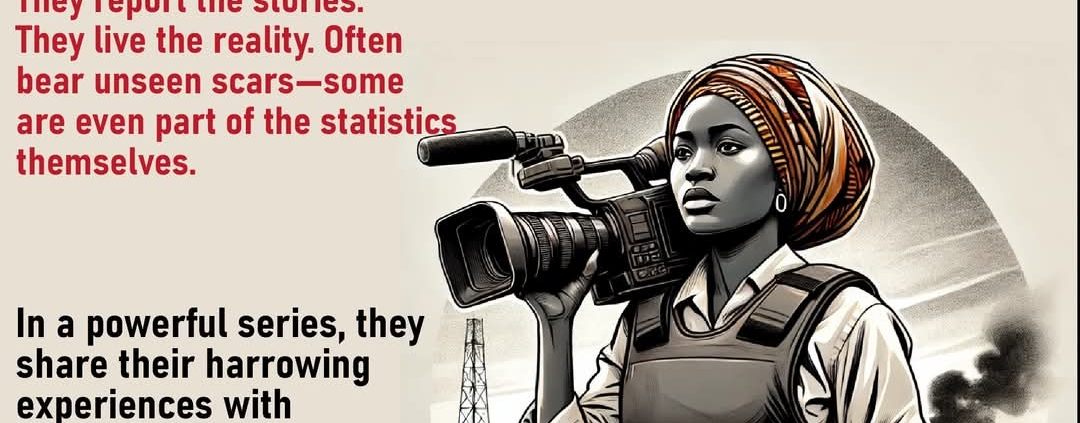
Defending the Defenders is a three-year story telling project profiling experiences of journalists who report on Violence Against Women and Girls (VAWG), and other female social justice defenders across Uganda and Africa. These “Defenders” not only amplify the suffering of survivors, but also silently carry their own psychological, Social and economic wounds.

Third Story

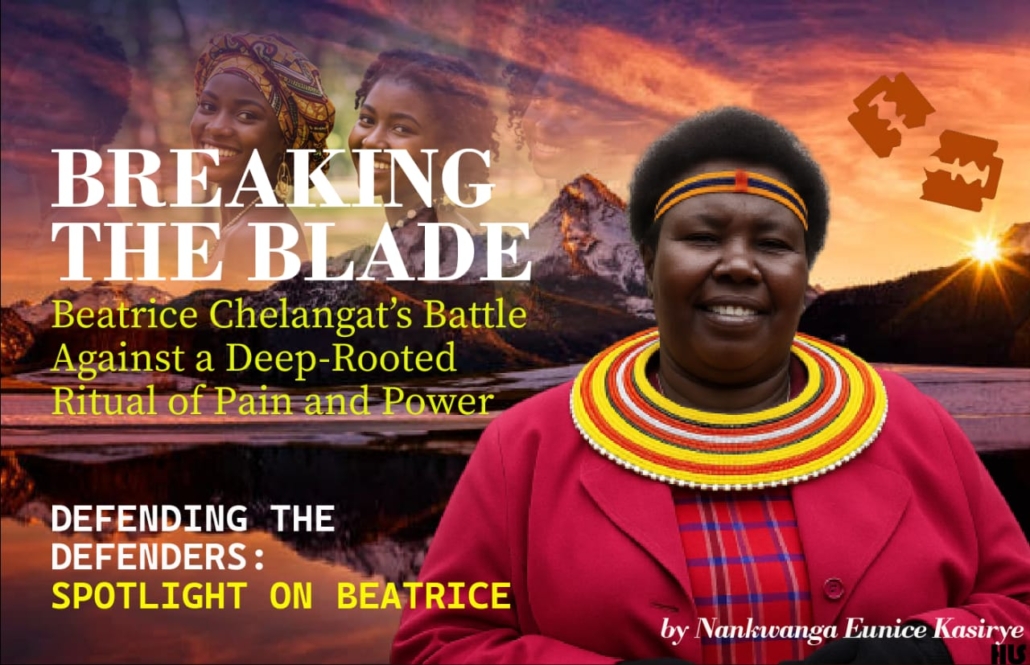
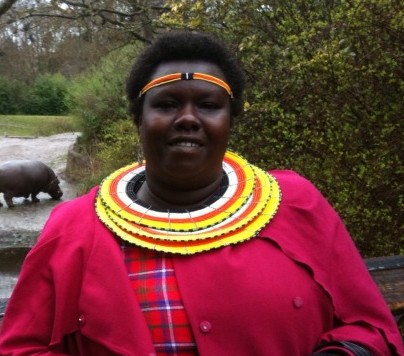
Breaking the Blade: Spotlight on Beatrice Chelangat
A SEED PLANTED IN THE HILLS


In 1976, deep in the mist-veiled hills of the Sabiny region in Eastern Uganda — where the mountains huddle together like ancient, brooding elders — a young girl named Beatrice Chelangat first heard whispers of female circumcision.
It was a Sunday morning, and the air smelled of damp earth and wood smoke. Millet fields bowed gently to the wind, and children’s laughter floated faintly between the ridges. Inside the small Anglican Church — a modest building of sunbaked bricks and timber, worn smooth by the hands of generations — the villagers had gathered, their bare feet dusting the earthen floor.

The archdeacon, a towering man in a heavy black robe, stood before the congregation. His voice, usually firm and commanding, trembled with something raw that morning — a wound too fresh to hide. Tears clung stubbornly to the corners of his eyes as he confessed: his own daughter, despite his strict warnings, had been secretly taken and circumcised at her uncle’s home.

The silence that followed was thick and stifling. It hung in the rafters and settled in the hearts of those present. His words, sharp and unrelenting, sliced through the women gathered at the front — mothers, grandmothers, aunts — accusing them of upholding a practice that some of the men, men like him, had dared to oppose in whispered defiance.

On a rough-hewn bench near the back, five-year-old Beatrice sat barefoot between her parents, the hem of her little dress gathered nervously in her fists. She could not fully grasp the meaning of what was being said, but something in the archdeacon’s brokenness carved itself into her spirit. She felt it — a strange, unfamiliar ache, a tightness in her small chest, as if the room itself had turned colder.

That day,” Beatrice would later recall, her voice steady but her eyes distant, “a seed was planted in my heart. A seed of questions… a seed of knowing that something about our way of life was hurting us.”

It was her first awakening — the moment she began to sense that what many called tradition was, in truth, a battleground. One not fought with spears and shields, but within homes, churches, and the quiet, anguished prayers of the faithful.

The Culture Beyond Church Walls

Yet, once outside the church’s stone walls, life carried on untouched. Among the Sabiny, FGM was more than a ritual; it was a permanent marker of honour, marriageability, and family pride.
Girls who evaded the blade were branded outcasts — whispered about in the marketplaces, their names carried by mocking songs around the evening fires where drums thudded into the night.

When Beatrice later joined Sabei College for her secondary education, the grip of tradition became even more visible. By Senior two,  at about the age of 15-16 years , girls around her pledged solemn oaths: to remain virgins until their circumcision day — a prized virtue zealously guarded and verified by appointed mentors.


Virginity was a currency; it promised higher dowries and a proud place in society.
Girls who didn’t keep their  virginity  until the cutting ritual-carried a permanent, invisible scar of shame.

At home, however, Beatrice’s world was different. While her friends celebrated their cuts with elaborate feasts, paraded through villages as ‘brave daughters,’ her own home remained silent.

Her father, a soft-spoken church warden, made no preparations for her initiation.
I don’t know how I was spared, Beatrice reflects today. Even now, it feels like an invisible hand shielded me.

Dancing Between Two Worlds

In 1988, when the district decreed that every girl must face the blade, Beatrice stood at the edge of a dark tradition, watching others prepare for the knife.

Her two younger brothers crossed into manhood with drums and ululations, their circumcisions celebrated with proud, public ceremony. Meanwhile, she — the eldest daughter — remained untouched, an invisible shield of silence surrounding her. Invitations flooded in for her cousins’ cutting ceremonies, and Beatrice answered them dutifully: stirring pots, leading songs, smiling for the elders. Yet beneath her bright eyes, a quiet defiance stirred.

When she left for Senior Five and Six in Mbale, the world shifted beneath her feet. Here, in this neighboring region, the blade did not hunt girls. Only boys were circumcised, and even then, it was stripped of the heavy, sacred cruelty she had known.

At the Christian Union meetings, she found a new language for the ache she had carried. What her people had baptized as “honor,” others called by its true names — “harm,” “sin,” “violence.” Her convictions against the blade hardened, forging themselves like steel in the fire of newfound belief.

But home was a harder battlefield.

Even after the district quietly rewrote the law to make FGM a choice, the invisible chains of tradition tightened cruelly. Girls who refused the knife were denied the ultimate symbol of womanhood — the “flower,” a green climber plant worn with pride, proof of courage and belonging.

Before 2007,” Beatrice says quietly, “they never gave me the flower. I simply accepted it.”

There is no bitterness in her voice, only a deep, settled strength.

I learned,” she says, her eyes distant but steady, “that my resilience was like a second skin — another body, covering mine, shielding me from a world that could not understand my refusal to bleed.

Inside the Rituals of Pain

Among the Sabiny people, the ritual of female circumcision was more than a rite of passage — it was a deep, painful imprint on a girl’s body, spirit, and future.
Unlike in other regions, FGM here meant a secondary circumcision: the cutting away of the clitoris and labia, without the stitches that other practices sometimes used. The wound was left open to the mercy of the body’s own strength — and the gods’.

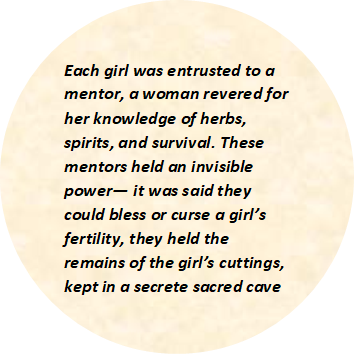
Each girl was entrusted to a mentor, often a traditional birth attendant, a woman revered for her knowledge of herbs, spirits, and survival. She became the girl’s shadow and guide, overseeing the initiation, the slow, aching healing, and the unseen spiritual binding that tied the girl forever to her community. These mentors held an invisible power, one whispered about around cooking fires — it was said they could bless or curse a girl’s fertility, her very fortune, by where they hid the sacred, severed parts of her body.
The first treatment after the cutting was almost as brutal as the act itself. The girl was led, trembling, to squat and urinate over her fresh wounds — a therapy of fire disguised as healing. The pain was so blinding that many screamed into the hard earth, their cries swallowed by the wind and the knowing silence of the women around them.

Traditional herbs — pungent, bitter — were packed into the wounds to fight infection and hasten the body’s repair. Healing took about thirty days. Once a week, a health worker from the government might come up the winding hills, bearing a small vial of PPF injection — a fragile thread connecting ancient ritual to the outside world.

But the true climax came not with healing, but with the Leopard Ceremony.

On that day, the entire village would gather, the air thick with the beat of drums that made the very ground pulse. The girls, now initiates, would stand bare-armed. In a final act of devotion, their skin was gashed with sharp blades — four deep cuts on the upper arm, each one a symbol of the leopard’s bite. These scars, like the leopard’s own fierce markings, would brand them for life — badges of courage and womanhood.
At the peak of the ritual, the drumming would stop — a sudden, eerie silence falling like a blanket over the crowd. In that stillness, it was said, the spirit of the leopard entered, sealing the girls’ transformation.

After the ceremony, their lives were no longer their own. Marriage awaited — often arranged long before, with dowries already exchanged. Whether their hearts agreed or not, tradition had already made the choice for them.

In the world of the Sabiny, a girl’s pain was her passport. Her scars, her new identity. Her future, no longer hers alone.

A Different Path for Beatrice

Fate had its own plans for Beatrice, carving a path that no one in her village could have foreseen.
In 1992, under the vast skies and the misty slopes of Mount Elgon, Beatrice achieved what no other Sabiny girl from the lands now known as Kapchorwa, Kween, and Bukwo  districts was able to achieve that year. She passed her advanced secondary school exams, earning a coveted government sponsorship to university — the only Sabiny girl that year. `

In those days, the life of a Sabiny girl was carefully scripted. Most were steered toward teaching in local primary schools, a profession seen as dignified, safe, and close enough to home to make good wives. Others were led straight from the thresholds of their initiation ceremonies into marriage, their futures sewn tightly to tradition.

But Beatrice was different. She quietly unstitched the heavy layers of expectation, one determined step at a time.

The old ways whispered that a Sabiny woman must marry within the tribe, bound by an ancient prophecy that warned of doom for any girl who dared to love beyond the ridges and rivers of her people. Those who disobeyed — who married “outsiders” — were condemned to fail and, in shame, to be returned home.

Yet the same prophecy did not bind Sabiny men. They took wives from distant lands, although those women often walked through life under the heavy cloud of suspicion, accused of witchcraft, and held at arm’s length by the community.

Against this backdrop of strict tradition, Beatrice stood — a living contradiction. She was uncut, a powerful statement in itself. She was highly educated, with books and faith tucked close to her heart instead of the ancestral expectations. In every sense, Beatrice was both a daughter of the Sabiny soil and a quiet rebellion against the forces that sought to define her.

In her stride was the courage of a generation that had been told to stay silent. In her story, the unspoken hopes of many girls — girls who, like the maize bending in the mountain winds, longed to reach for the open sky but were rooted by the old ways — finally found a voice.

The Call to Serve

During her first university holiday, Beatrice was crouched by the fire in her family’s open-air kitchen, the smoke curling into the afternoon sky and clinging to her hair and clothes. The heavy scent of burning firewood, the bubbling stew in the pot, the faint chatter of women pounding millet in the distance — it was the familiar hum of life in the Sabiny hills.

That’s when the archdeacon arrived, the same man who had once mourned the loss of his own daughter to the knife. His face was lined with years of grief and hope. Standing at the edge of the kitchen, he cleared his throat, and Beatrice looked up, squinting through the smoke.
“You must come back,” he said, his voice carrying the weight of a prayer. “Come back and fight this battle. You are proof that a Sabiny girl can be whole — untouched — and still be honored.”

Beatrice lowered her gaze, the ladle trembling slightly in her hand. She bowed out of respect, her heart caught between two worlds.
Inside her, a quiet ache stirred — the pull of dreams shaped far beyond the hills: gleaming glass buildings, the hush of air-conditioned offices, polished floors clicking under high-heeled shoes.

I dreamed of Kampala,” she says now, her voice soft with memory.

But fate — stubborn and patient like the mountains — was already threading her back into the fabric of her people’s story.

Quiet Beginnings of a Storm

After her final university exams, Beatrice stood at the edge of Kampala’s restless streets with a heavy heart and an empty pocket. Jobs were whispers in the wind — promises that never quite reached her. With no opportunities in sight, she made her way back to her village, where life moved to the steady rhythm of sun and soil.

Home meant mornings draped in mist, where she worked alongside her father on the family farm. Together, they planted maize and beans in the wide, open fields, the earth warm and familiar under their bare feet, the sky above a restless ocean of clouds. In those long days, bending over rows of crops, Beatrice found quiet strength — but also a restless yearning for more.

In 1995, opportunity arrived in a form so humble it nearly slipped past unnoticed. She was invited to usher at a public gathering organized by the local Member of Parliament — a day marked by the smell of roasting maize, colorful kitenge fabrics fluttering in the breeze, and the hum of elders’ conversations under the old fig trees.

What began as a small task became a turning point. Impressed by her poise and attentiveness, the Woman Member of Parliament, in collaboration with the United Nations Population Fund (UNFPA), recruited Beatrice for a discreet assignment: to document a “Reproductive Health Workshop.” Beneath that careful title was a bold mission — confronting the deep-rooted tradition of female genital mutilation (FGM) without igniting anger or shame among the proud Sabiny.

Armed with nothing more than a pen, a notebook, and an unwavering belief in the dignity of her people, Beatrice captured every whispered concern, every cautious question, every quiet act of courage. Her report, crafted in the language of respect and understanding, blossomed into something bigger: a concept paper, and eventually, the birth of a project — Reproductive Education and Community Health (REACH).

Through storytelling circles under mango trees, quiet home visits, and community dialogues woven into market days and church gatherings, REACH began to gently peel back generations of silence. It was not a battle waged with shouting and shame, but a slow, compassionate revolution rooted in the everyday life of the Sabiny people.

Within just one year, the seemingly unmovable tradition shifted — FGM rates fell by 36%. No headlines announced it. No drums were beaten in celebration. But in the hearts of daughters and mothers alike, a new story was beginning to grow — one of hope, dignity, and change carried on the soft winds of their mountain home.

Facing the Backlash

However, resistance flared like a wildfire in the dry grasslands of Sebei.

When REACH convened a gathering of 300 elders—custodians of tradition, seated in their kanzus and cloaks, leaning on walking sticks worn smooth by time—what was meant to be a dialogue turned into a storm.

The air grew thick with anger. Beatrice and her team stood at the front, hopeful, armed only with facts and fragile hope. But soon, voices rose like thunder.

You are here to destroy us!” someone shouted.
Western agents!” others hissed.

The elders, pillars of the community, turned hostile. Stones of insult were hurled—some literal, most verbal.

Beatrice remembers the moment vividly:
The chaos…” she pauses, voice tightening, “…sent us into hiding for two months. We feared for our lives.”

It felt like exile in their own land.

But they didn’t give up.

In the quiet after the storm, they changed course. No more direct confrontations. They began to work beneath the surface—like the roots of the banana plant, steady and patient.

They sponsored girls’ education silently, offered support to youth groups humming with fresh energy, and started building a small health centre—brick by brick, hope by hope. They listened more, talked less, and slowly drew in a few sympathetic elders who were willing to reimagine the future.

Bit by bit, they planted seeds of change, knowing that in Sabiny tradition, even the stubbornest millet stalk can bend when rain and sun take turns to soften it.

New Traditions, New Resistance

Beatrice kept breaking barriers, one brave step at a time.
In the heart of the Sabiny hills, where tradition runs deep like the rivers cutting through the valleys, she dared to reimagine custom itself. She staged her own modern traditional marriage — with bright tents billowing in the wind, rows of plastic chairs under the open sky, and songs rising over the village fields. It was a wedding not hidden in whispers but celebrated boldly before the entire community. That day, she didn’t just marry — she carved a new path that many would follow.

But as the drums of change grew louder, so too did the storm of resistance.
Authorities froze REACH’s bank accounts without warning, leaving her team stranded. Trolls, emboldened by anonymity, hurled insults at her family across radios and market squares. Strangers, some once friends, came pleading to her father, urging him to “bring his daughter back into line.

Still, Beatrice stood tall, her voice steady against the winds.
I knew,” she says, her eyes reflecting years of battles fought in silence, “that change comes with scars.”

The scars ran deep.
In 2004, while working on a documentary, whispers grew into a deadly plot: a plan to seize and forcefully circumcise her deputy and their team. Under the cover of night, they fled on foot, abandoning their vehicles among the maize fields, hearts pounding, prayers slipping from their lips.
Ten years later, in 2014, the fight hit even closer to home.
Some of Beatrice’s own relatives were arrested for carrying out illegal FGM rituals. Amid the chaos, a woman — heavy with twin pregnancy — miscarried while in detention. Grief quickly turned to fury.
The hills that once echoed with celebration now roared with violent demonstrations — and Beatrice stood once more at the center of the storm, her dream bloodied but unbroken.

Beatrice’s Quiet Revolution: A Legacy Rooted in Courage 

Beatrice Chilangati and her allies moved from village to village, weaving through narrow footpaths, sitting under the shade of old fig trees, speaking in hushed yet determined tones to elders, mothers, and girls whose lives were stitched tightly to tradition.
Their mission was simple yet revolutionary: to end the centuries-old practice of Female Genital Mutilation (FGM).

By 2009, after countless fireside conversations, sleepless nights, and moments when hope seemed just a flicker against the vast Sabiny skies, the impossible happened — Kapchorwa District passed an ordinance banning FGM.
Later that same year, with the support of Hon. Chris Baryomunsi and Hon. Dorah Byamukama, the momentum spread across Uganda, culminating in a national ban.

President Yoweri Museveni, recognizing the depth of Beatrice’s sacrifice and vision, sponsored 30 young Sabiny girls to attend university — a powerful symbol that the future of a community could be rewritten.

Even more remarkable, the traditional cutters — women once revered for ushering girls into womanhood — were not abandoned. Instead, they were retrained as reproductive health advocates, their hands once instruments of pain now offering healing and hope.

When I look around now,” Beatrice says, her voice quivering with emotion, I see girls in classrooms, laughter spilling from dusty playgrounds, and dreams that reach beyond early marriage. I see smiles where once there was only fear.”

Her eyes, bright as the morning sun breaking over the Kapchorwa cliffs, carry the weight of battles fought and won.

Walking Through Fire, Emerging Whole

Beatrice’s journey is a testament to the extraordinary strength one woman can summon from deep within her bones — strength rooted in resilience, grace, and unshakable faith.
She endured rejection from her own, betrayal by those she trusted, and the heavy, sometimes silent, resistance of an entire culture.
Yet she never yielded.

Even now,” she says, tracing her memories along the ridges of her homeland, “I walk the hills knowing that the forest I crossed — though thick and dark — was not in vain.”

The dust on her feet, the songs in the air, the shy smiles of young girls fetching water at the riverbank — all whisper of a new legacy, one built on courage and compassion.

FGM in Uganda — The Broader Fight

Today, Uganda’s national FGM prevalence has dropped below 1.4% (UNICEF, 2023) — a stunning achievement.
Yet in remote corners like the Sebei and Karamoja regions, particularly among the Sabiny and Pokot communities, the old ways still linger, hidden among mountain passes and border villages.

The fight continues, through:

  • Community dialogues that gather elders, mothers, and youth under the familiar shade of community trees.
  • Alternative Rites of Passage that honor tradition without bloodshed.
  • Strict enforcement of the 2010 FGM Act to hold offenders accountable.
  • Economic empowerment programs that offer former cutters a dignified livelihood.
  • Cross-border collaborations with Kenya to seal the escape routes for harmful practices.

This fight is not just about changing laws — it is about healing generations.
It is about creating a world where no girl will ever again have to trade her dreams for survival.

And thanks to defenders like Beatrice, the hills of Sebei echo not just with ancient songs, but with the laughter of girls who are free.
By Nankwanga Eunice Kasirye

Defending the Defenders is a three-year story telling project profiling experiences of journalists who report on Violence Against Women and Girls (VAWG), and other female social justice defenders across Uganda and Africa. These “Defenders” not only amplify the suffering of survivors, but also silently carry their own psychological, Social and economic wounds.

Second Story


A Mother Caught in Endless Conflict

Determined to comprehend the roots of this endless bloodshed, she pursued an education in political science, believing that knowledge was her strongest weapon against the forces that sought to silence her.

A Journalist on the Run, A Voice That Won’t Be Silenced

ZamZam believed in the power of truth, so she became a journalist. She exposed the brutal reality of Sudan’s conflicts, working as a freelance reporter, publishing stories without pay,she sounded the trumpet in all the available spaces she could access- her social media pages became the wall of the cries of her people- driven only by the urgency of amplifying the voices of the oppressed.

Her fearless reporting made her a target. The government labelled her a traitor, militias called her an enemy, and she was arrested twice, each time warned that her journalism would cost her life. Still, she refused to stop. She was later banished by all factions from her community.

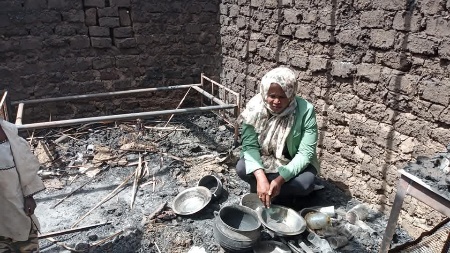
Zam inspect one of the homes burnt down in 2019, in Darfur by militias


The Darfur conflict, which began in 2003, has left a devastating mark on Sudan. The  Janjaweed militias have waged a campaign of ethnic cleansing against non-Arab communities, committing mass murder, sexual violence, and village destruction. More than 300,000 people have been killed, and over 3 million have been displaced.

Survivors live in fear, knowing that there is no justice—no courts, no police, no one to hold perpetrators accountable. Men are executed on sight. Women, left as the sole providers, are brutalized, gang-raped as they search for food and firewood.

ZamZam has seen these horrors firsthand. She once found a mass grave where seventeen community members had been murdered and pilled . In another instance, she came across a mother and her seven-year-old daughter—both victims of a gang rape. The child was bleeding, her small body broken. There was no doctor, no medicine, no hope.

Risking her own life, ZamZam went out to look for medicine to treat the child, knowing full well that even stepping outside could mean death.

“I have seen things no human being should ever have to see. But the world looks away while my people suffer. If no one will fight for them, I will.” — ZamZam reaffirms, her voice heavy with anguish.

From the War in Khartoum to Exile in Uganda

When war erupted in Khartoum in 2023, journalists became primary targets. Within months, eleven of ZamZam’s colleagues were assassinated for their reporting. Fearing she would be next, she fled to Uganda. But her struggles did not end there. Food is scarce, shelter uncertain, and the fear of being hunted never leaves her.

“Exile is not freedom. It is just another kind of prison. The only difference is that here, the bars are invisible.” — her voice laced with quiet despair.

A Mother’s Endless Worry

Though she is physically safe, ZamZam’s soul remains in Sudan. Her children are still trapped in the conflict, and communication is rare. Days pass with no news, leaving her gripped by fear. Recently, the home where her children were staying was attacked just because the people there were her blood relatives. Three young men were executed as the children watched.

She is torn between staying in Uganda, where she has no resources or community, and returning to Sudan, where certain death awaits. The weight of helplessness crushes her.

“I am a mother first. If I cannot protect my children, then what is the point of my survival? The anxiety over their safety is killing me. I barely sleep, I have tremors, hallucinations, always looking over my shoulder, thinking someone is following me… It is too much, yet I cannot be silenced.” —  her words suffused with aching sorrow.

A Call for Solidarity

ZamZam has fought alone for too long. She needs a community that will stand with her, journalists who will share her burden, and support—financial, social, mental, and psychological—to keep her going. Her story is not just hers; it is the story of a people fighting for their right to exist.

She will not stop fighting, but she needs the world to listen.
“I don’t ask for pity. I ask for action. Stand with me, stand with my people, and together, we can bring change.” — her plea echoing with unwavering determination.

By Nankwanga Eunice Kasirye

Defending the Defenders is a three-year story telling project profiling experiences of journalists who report on Violence Against Women and Girls (VAWG), and other female social justice defenders across Uganda and Africa. These “Defenders” not only amplify the suffering of survivors, but also silently carry their own psychological, Social and economic wounds.

First Story
Yvonne Moka’s Fight for Justice Begins with a Tear-Stained Story

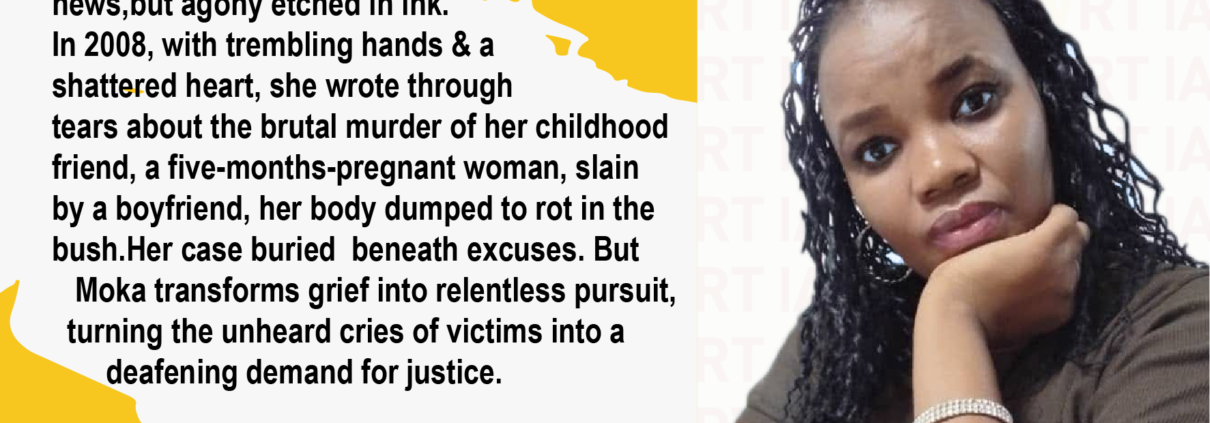
Yvonne Moka never imagined that reporting on femicide and violence against women and girls (VAWG) would mean reliving her own nightmares. Each story she tells is not just a battle for justice but also a fight for her own sanity. In a chilling interview, she reveals the haunting weight of being both a journalist and a survivor.

Yvonne Moka, a passionate social justice journalist from Botswana, never anticipated that her first major social justice story would be the one that shattered her heart.

“My home girl, we grew up together. We shared everything—church, music, village life. She was like my sister. When I left for university, she stayed behind. Over time, she began dating a gangster from the village, and I was not pleased,” Moka recalls. “But she made her choices. Then, one fateful day, I received a call from her neighbor: ‘She’s dead. The boyfriend has killed her.’” Moka’s voice breaks with grief as she recalls the memory of her friend’s murder, even though it has been more than 15 years.

In December 2008, Yvonne, a young journalist at the time, wrote her first story—a heart-wrenching piece born from a broken heart. She wrote through tears, her hands trembling as grief poured out onto the page. Her childhood friend had been brutally murdered by her boyfriend. The man, under the influence of drugs, killed her while she was pregnant and discarded her body in a bush. By the time the police found her, her body had already decomposed.

Yet, despite clear evidence and phone records pointing to the perpetrators, the justice system failed to bring the criminals to justice. “They were well-connected. After a brief detention, they walked free. It was as if their privilege shielded them from justice,” Moka says bitterly. “The killers of my homegirl are still walking free today, and the case remains unresolved.”

Justice Lost in a Broken System

Moka’s pursuit of justice for her friend led her down a path of frustration and dead ends. “The last time I followed up on this case was in 2020,” she shares. “And guess what? The public prosecutors still say they can’t find the file. One minute, the guy handling the case has been transferred. The next minute, the file is just… gone.”

But the tragic loss did not end there. Another life was cut short—one that hit even closer to home. Moka’s own memories of a promising woman, just about to complete her final-year exams, were shattered. On that fateful day, her boyfriend, a soldier, strangled her with his gun belt before taking his own life.

For the public, it was another tragic headline. But for Moka, it was a wound that never fully healed. “I still remember it like it was yesterday—her body hanging from the rooftop, the blood, the pain. And worst of all, she had kids… three little kids left without a mother,” Moka says tearfully.

More Than Just a Story

Moka’s heartbreak isn’t limited to the stories she tells. She made the long journey to the Central District for the funeral, needing to stand among the mourners—not as a reporter, but as a human being.

The reality of the loss weighed heavily on her. This young woman had worked tirelessly for a better life, just as Moka had. Yet instead of celebrating her graduation, she was being mourned in a coffin.

“She was just like me—a daughter, a student, a woman with dreams. But she never got to live them. That thought still haunts me every time I write,” Moka reflects.

The Faces Behind the Headlines

Over the years, Moka has covered countless cases of women trapped in abusive relationships—many of whom never made it out alive. Just last year, in 2024, a prominent woman was killed by her boyfriend. Moka had been in touch with her only weeks before, listening to voice notes filled with fear and despair.

Later, at a project launch under the Global Forum of Women Entrepreneurs, Moka stood before a board displaying the faces of over 15 women—all murdered by their partners. She had known more than 10 of them personally. She had spoken to them. She had told their stories. Now, she could only mourn them.

“I looked at those photos, and I cried. These weren’t just stories. They were real women—women I had talked to, women who had dreams, women who should still be alive,” Moka says, her voice heavy with emotion.

The Unseen Toll on a Journalist’s Soul

For many, these tragedies exist only in passing—a brief moment of sorrow before moving on. But for Moka, the weight of these stories never fades. Journalists are expected to churn out multiple stories a week, with no time to grieve or process the horrors they witness. One day, Moka is attending a funeral 600 kilometers away; the next, she is covering another heartbreaking case.

“There’s no time to cry. No time to breathe. You’re expected to move on, find the next story. But how do you move on when you’ve just watched a mother’s children bury her?” Moka says with a tone of despair.

No Support, No Relief—Only Survival

The weight of these stories haunt her. She remembers vividly standing by as a woman’s body was exhumed from a shallow grave. She had been murdered by a former boyfriend who, after marrying another woman, refused to let go of his past. The details—the smell, the red nail polish on her lifeless hands—are forever fresh in Moka’s memory. And yet, there was no emotional support or mental health resources from her workplace. There was only the expectation to keep going.

“There was nothing—no emotional support, no therapy, no debriefing. I had to rely on my faith, on my books, on my prayers. Because if I didn’t, I don’t know how I would have survived,” she says.

The Unseen Toll: Reporting Violence, Living the Trauma

Moka’s story is not unique. It is one of many shared by female journalists who cover femicide and Violence Against Women and Girls. “These are just a few cases among dozens that I have reported on. I’ve covered countless women and girls murdered by their intimate partners, and in many cases, justice was never served,” Moka reflects.

For Moka, and journalists like her, reporting on femicide is not just a job—it is a battle against systemic indifference, corruption, and failure. “It tears me apart every time I write these stories. These women were like sisters to me. I can’t just report their deaths as if they were statistics. Their pain stays with me,” Moka shares. “Writing these stories is like reliving the grief over and over again. But I do it because no one else will.”

A World in Denial: The Global Femicide Crisis

Moka’s heartbreak is not isolated—it is echoed around the world. According to the United Nations, in 2023 alone, 85,000 women and girls were killed intentionally. Of those, 51,100 were murdered by an intimate partner or family member. That means 140 women and girls were killed every day—one woman every ten minutes.

Female journalists covering violence against women and girls are not just exposing injustice—they are risking their own safety. The same violence they report on is the same violence that threatens them.

Moka’s story is just the beginning. In the next part of this series, more female journalists will share their own harrowing accounts of reporting femicide and Violence Against Women and Girls. Their stories are painful, but they are also a testament to courage, resilience, and the fight for justice.

As these journalists risk everything to expose the horrors inflicted on women and girls, society must step up. Their work is essential, and their safety must be a priority. These women are not just reporting the news—they are breaking the silence, one story at a time.


President’s Message

Dear Members,

Warmest greetings! This year has begun with much positive energy and activity from IAWRT chapters across the world.

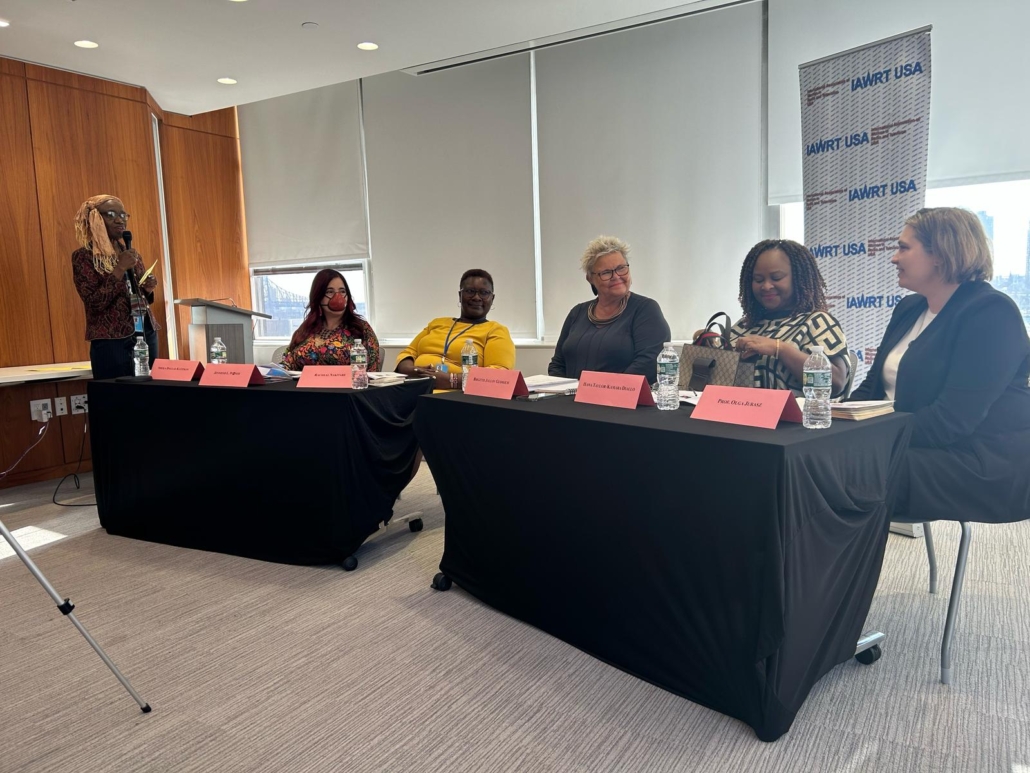
Let me start with the Commission of Status of Women (CSW 69) where the parallel event panel discussion on Section J of the Beijing Declaration: Gains and Reversals, organized by IAWRT USA became a wonderful reunion of our colleagues. A brief report is available here and a more detailed report will be circulated later.

This was a good opportunity for those members who managed to travel to New York, and it was great to see all of them participating and working together to make the event a success. Some of our colleagues who attended the event were Violet Gonda and Rachel Nakitare (previous IAWRT presidents), Mandira Raut, IAWRT Secretary, Birgitte Jalov, previous board member, Josephine Karani IAWRT Treasurer, and IAWRT USA led by Sheila Katzman, Chapter head with members including Pamela Morgan, Rebecca Miles, Olivia Tumanjong, Bethann, Monica and others.

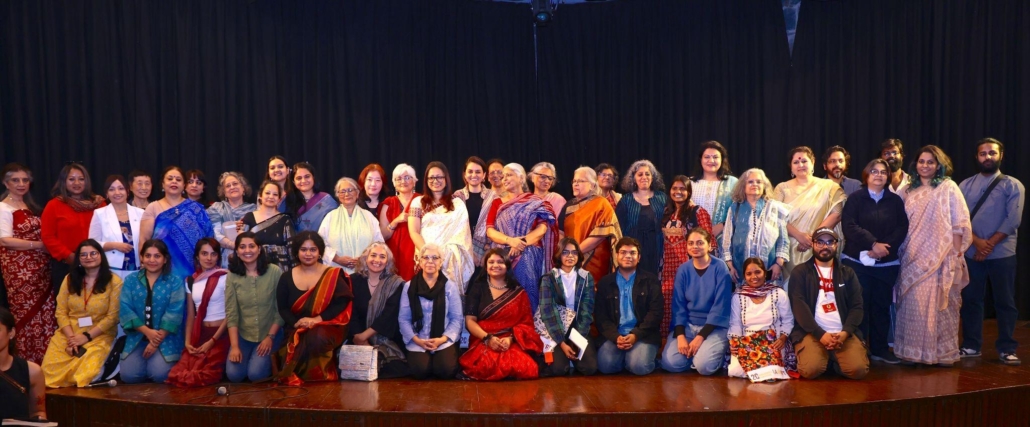
The month of March is indeed an opportunity for all of us women to hold different events to share our voices with the world. It started in India where the annual Asian Women’s Film Festival, with multiple workshops, screenings and panel discussions from March 6 to 8, 2025, was widely attended by participants from Delhi and IAWRT members from across India and Nepal. The report demonstrates what a vibrant event it was, with several other events, including a filmmaking workshop in February, a panel discussion and a film competition being organized as a part of the runup to the festival.


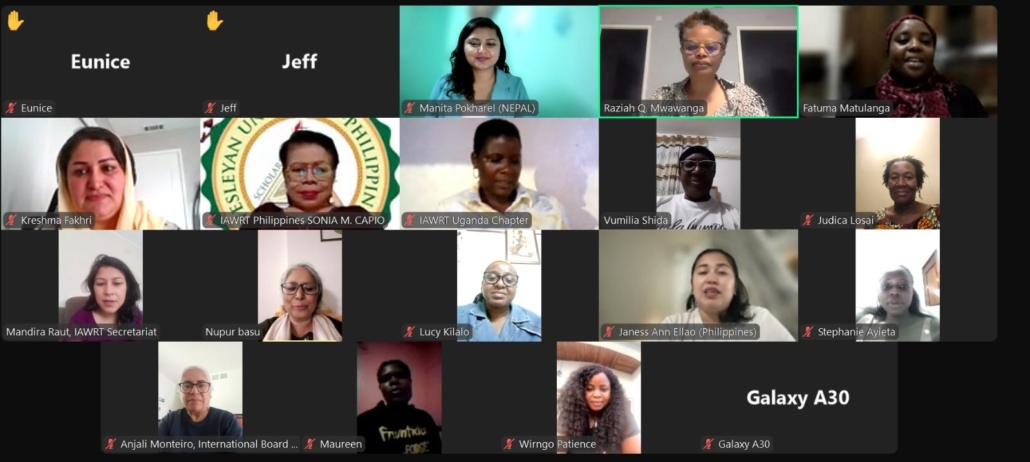
The IAWRT International also celebrated International Women’s Day by holding a webinar, on the theme ‘Urgency for Women Journalists’ Safety and Security’ moderated by Raziah Q. Mwawanga. Participants comprised IAWRT global members, chapter heads and stakeholders from the media sector. Presentations were made by Kenya, the Philippines, Tanzania, Uganda, Cameroon, Afghanistan, Nepal, India and the United States chapters, who presented national perspectives and potential solutions. A detailed report has been prepared.

News from our Chapters

The Norwegian chapter board held its annual meeting in March, and soon after received funding for a project to train Afghan women in Norway to make podcasts – a continuation of the last projects it has done. It is now in dialogue with Zan Times, a promising and exciting collaborative opportunity. Zan Times is a wonderful online platform, which our board member Kreshma Fakhri is involved in producing, that powerfully brings out, through local voices, the predicament of Afghan girls and women.

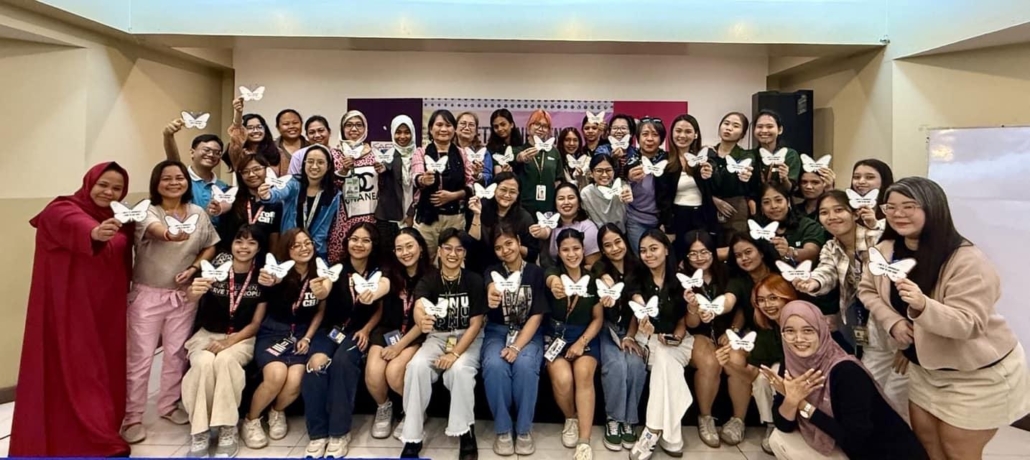
The Philippines chapter held a Safety Conference for Women Journalists: Gendered Experiences in Election Coverage on March 8 and 9, 2025, dealing with the BARMM elections. The second day of the training included a public forum, extending the reach of the program to students and the wider community. The Philippines chapter also has various other initiatives, including research and advocacy.


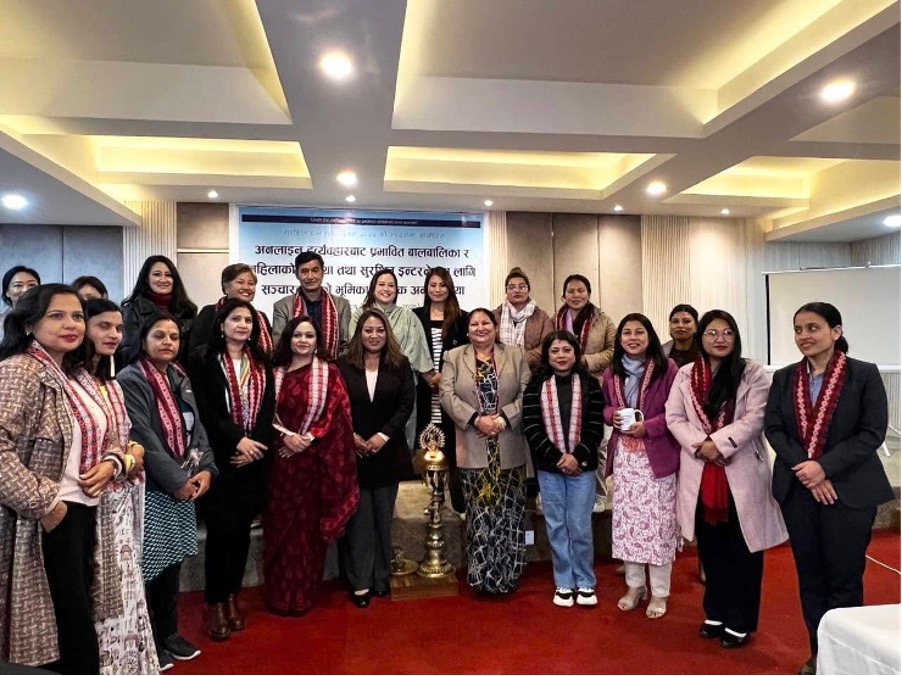
IAWRT Nepal has organized various events, including a Safer Internet Day. The chapter also participated in theAsian Women’s Film Festival in Delhi and the Kathmandu PinkCareAthon.


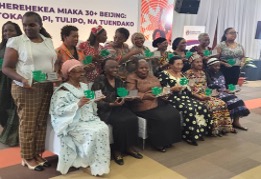
IAWRT Tanzania too has had many activities, with a workshop, collaborations, a mentorship program and participation in events. We’re delighted to inform you that Founder President Rose Haji Mwalimu received the accolade of Kinara Wa Beijing 1995 (Pioneers Of Beijing 1995) from Women Fund Tanzania (WFT). Our congratulations to her! Details of all these events and initiatives, of the Philippines, Nepal and Tanzania chapters are available here.

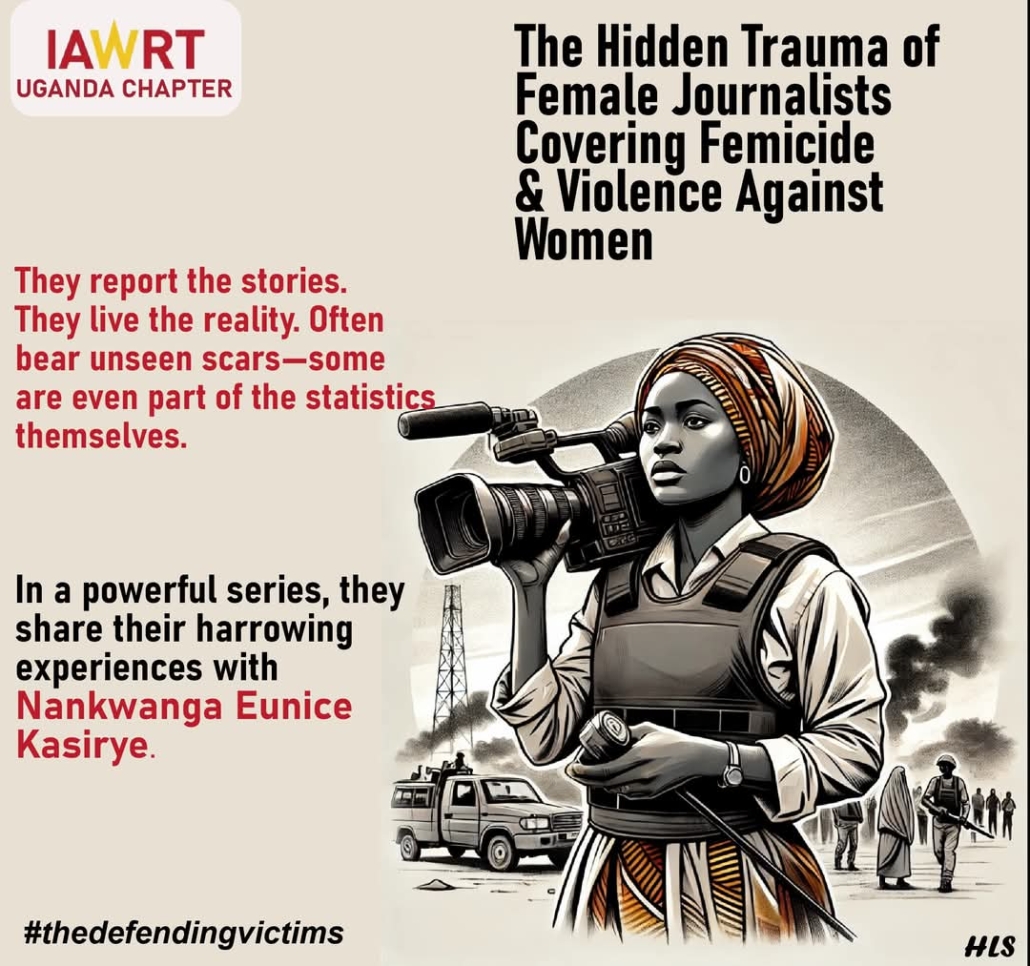
Our colleague from IAWRT Uganda, Nankwanga Eunice Kasirye, Chapter head, is publishing a series of stories entitled Defending the Defenders. This is a three year project on women journalists, sharing their struggles and experiences through her blog. More on this interesting project here.


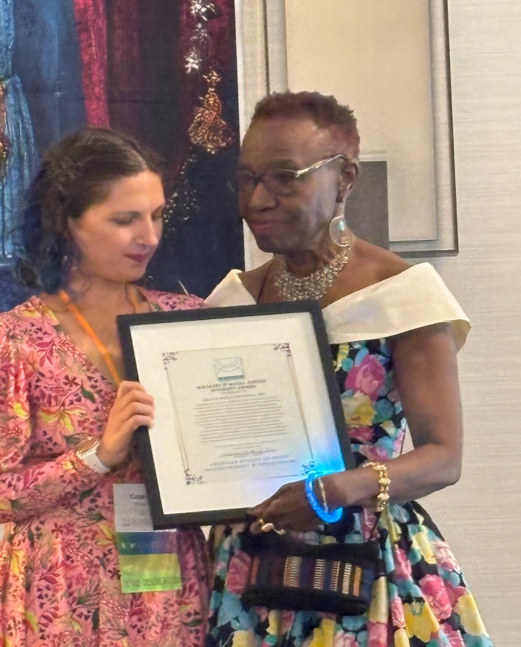
We congratulate Sheila Katzman, Chapter Head USA, on her recent awards from the American Society for Group Psychotherapy and Psychodrama, details here.


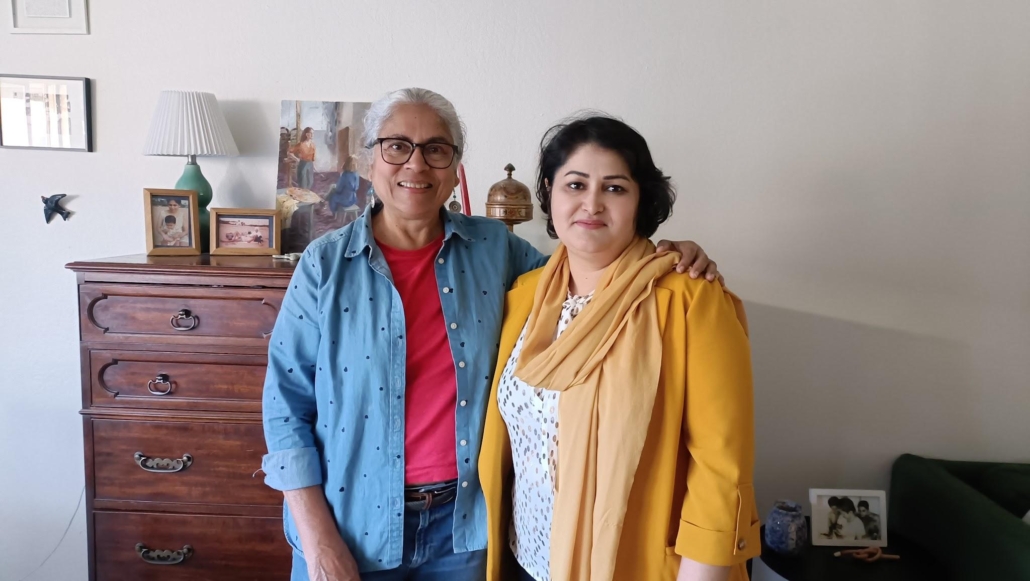
Sisterhood is indeed heartwarming and energizing wherever we are. The CSW was an opportunity for many from IAWRT to meet. Additionally, IAWRT Board Members, Anjali Monteiro and Kreshma Fakhri met in California, USA. Kreshma has relocated to California and Anjali was visiting the US on holiday.


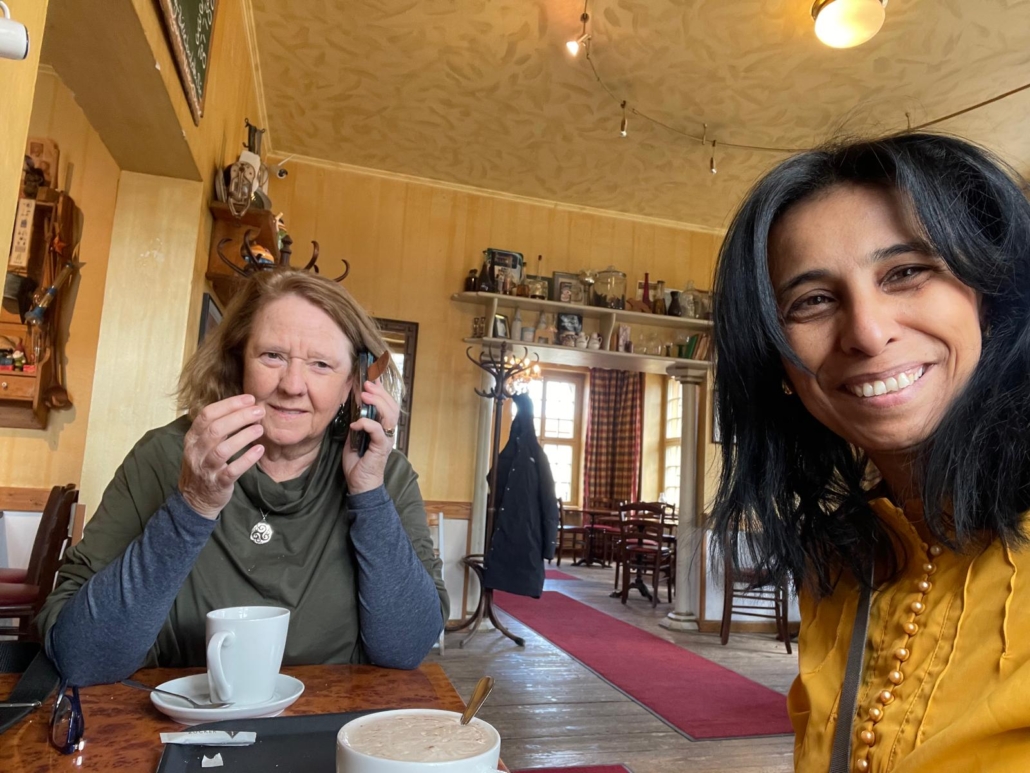
Abeer Saady and Nonee Walsh met in Germany in April. The two IAWRT members are responsible for the IAWRT Safety handbook “What if…”. Abeer is a previous IAWRT vice president, while Nonee is our past Board Member and our web journalist for many years.

We also came out with a statement on International Women’s Day to express our solidarity with all women journalists and media persons as they struggle for freedom of expression and for amplifying women’s voices in these difficult times.

It gives me great pleasure to inform you that our 40th Biennial meeting will take place in Kathmandu, Nepal from November 14-16, 2025, on the theme: Gender Justice in a Conflicted World. We do hope that many of you will be able to make it to the Biennial. This forthcoming three-day event symbolizes a significant milestone in our ongoing commitment to fostering gender equality in media and also a critical moment for global gender justice advocacy. The sub-themes that we will be addressing, both through plenary sessions and workshops include the following:

Gendered Impacts of Conflict and the Response of Women in the Media

Digital Safety for Women Journalists

Climate Change, Conflict, and Gender

Media as a Tool for Gender Justice- Innovative Approaches

We also take this opportunity to seek your support through our crowdfunding campaign on the GoFundMe platform, which is one of the ways through which we are trying to garner resources for the Biennial:


As you would all be aware, the current situation is one where funding opportunities for all organizations have become increasingly scarce. We have formed a Biennial Committee and a local Secretariat in Nepal. All of us are working very hard to raise funds for the event. IAWRT International has been struggling to raise resources these past two years to keep the secretariat going and is trying every avenue to seek funding for the Biennial. The total amount we have to raise for the biennial is NOK 435,000 (approximately USD 38,000). Your support to this crowdfunding campaign, both by contributing yourself and by sharing it with your contacts, would go a long way in facilitating the event. Whether you contribute USD 10 (NOK 111) or USD 100 (NOK 1114) or any other amount, every little bit matters and makes a difference.

We look forward to your support, and to meeting you in Kathmandu in person or online later this year, for our Biennial and our General Assembly! We will be sending you more details about the Biennial shortly.

Always take care.

Best regards,

Jola


By Nankwanga Eunice Kasirye

Defending the Defenders is a three-year story telling project profiling experiences of journalists who report on Violence Against Women and Girls (VAWG), and other female social justice defenders across Uganda and Africa. These “Defenders” not only amplify the suffering of survivors, but also silently carry their own psychological, Social and economic wounds.

Through their reporting, they create awareness and hold hands of others yet no one asks how they are copping. Society assumes they are immune to the violate they expose, overlooking their own vulnerability and pain. Defending the Defenders therefore seeks to break this silence, honour the emotional truths behind the professional bravery.

The project profiles two stories every month. Early examples include Beatrice Chelengant, a Uganda activist against Female Genital Mutilation (FGM), she was trolled, bullied, threatened and resented by her own people but remains a symbol of hope and dignity. Yvonne Moka of Botswana, fights with deep psychological trauma, after years of reporting about VAWG, finds solace in religion. And ZamZam, a Sudanese journalist lives under constant death threats for exposing decades of unrest in
Darfur region, she refused to be silenced. These are not just stories but chronicles of women warriors, wounded, yet refuse to retreat- fighting for the safety and dignity of every woman and girl.

The project builds a data base for the defenders, conduct background research, get in touch, plan and schedule for the interviews physical or virtual. I write the original scripts, collaborate on visuals, publish on my blog and social platforms, engage other publications to amplify visibility.

Explanation
Defending the Defenders story telling project addresses a critical gap often overlooked in reporting Violence Against Women and Girls (VAWG), the emotional psychological, social and economic toll these female journalists and other social justice defenders face while doing their work.

Most attention is on survivors in these reports, reporters could be facing the same violence and the toll she cultivates from being the witness and the bearer of the pain of the survivors. They amplify the voices of the survivors but no one checks on them, no one amplifies their plight- yet, silently the defender as a woman faces the same violence.

Defending the Defenders therefore seeks to break the silence, turn the microphone to the frontline defenders, who carry the double burden as survivors of the violence thy report on as well as pain from being the bearers and witnesses to the survivors’ pain.

The project is a turning point for the reporters of the stories become sources, survivors in their own right. This is to honour their emotional bravery and recognise their vulnerability. This will in the long run turn the data base of contacts, into a peer safe community, to hold each other’s hand from a place of understanding without the need to try to prove bravery but seek and accept support were one feels empty to keep going. Break the silence and create a judgement free community for the
defenders through solidarity and collaborations.

Methodology

Defending the Defenders uses mixed methods story telling approach to collect and document experiences of journalists who report on Violence Against Women and Girls (VAWG), and other female social justice defenders across Uganda and Africa.

Data Collection

The project identifies, mobilises and develops a pool of potential subjects identified through content analysis of the available and accessible content from physical media houses, organisations reports, social media platforms and, professional networks. The criterion includes consistent demonstrated engagement in VAWG reporting or social justice.

Background research is conducted to contextualise each subject’s professional course and public visibility. Semi-structured interviews are then arranged either physical in the, agreed upon locations or virtual via encrypted communication platforms to ensure participants safety and flexibility. Interviews are designed to elicit rich first-person narratives focusing on personal challenges, emotional burdens, professional risks, copping strategies and broader societal responses to their
work.

Data Analysis
Collected data is analysed through thematic analysis. Interviews, transcripts, field notes and secondary materials are coded to identify recurring themes such as secondary trauma, societal backlash, professional isolation, financial uncertainty, coping mechanisms and pathways to resilience. Attention is given to the intersectional factors such as geographical context, ethnicity and type of activism. The analysis seeks not only to narrate individual experiences but to map patterns that illustrate broader systemic issues affecting female defenders.

Content Production
I craft the original stories from the data, weaving quotes and lived experiences into compelling narratives. Each is accompanied by carefully designed content such as digital banners and cards as well as infographics developed through collaboration with graphics designers to enhance engagement and visibility.

Publication and amplification

The final pieces are primarily published on my personal Blog
https://nankwangaeunice.blogspot.com and cross shared on personal social media platforms as well as International Association of Women in Radio and Television (IAWRT). Going forward, I am actively engaging with broader media outlets and advocacy organisations to secure to secure publication and partnerships that amplify the stories to new audiences. This is intended to humanise the women behind the frontlines of the fight to stop VAWG.

Impact
Over three years Defending the Defenders aims to create and establish a vibrant multimedia archives that not only documents the emotional cost of frontline work but seeds a peer support community. By recognising these dual burden these defenders carry, the project aspires to break their silence, normalise seeking support and foster solidarity, healing and resilience among women defenders.

From December 4 to 6, 2025, we are planning our 40th Biennial Conference – a rare, in-person gathering of our global community – in Bangkok, Thailand under the theme: “Gender Justice in a Conflicted World.”

These biennial conferences are not just meetings. They are transformative spaces where we forge trust, solidarity, and strategy. In a world marked by conflict, climate disruption, and inequality, these gatherings help us imagine and build a better future together.

This is your invitation to stand with us. Every contribution — big or small — brings us one step closer to making this vital gathering a reality.

Together, let’s make Kathmandu happen.

Let’s keep IAWRT vibrant, connected, and bold in its vision.