By Nonee Walsh
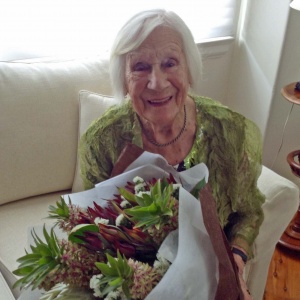
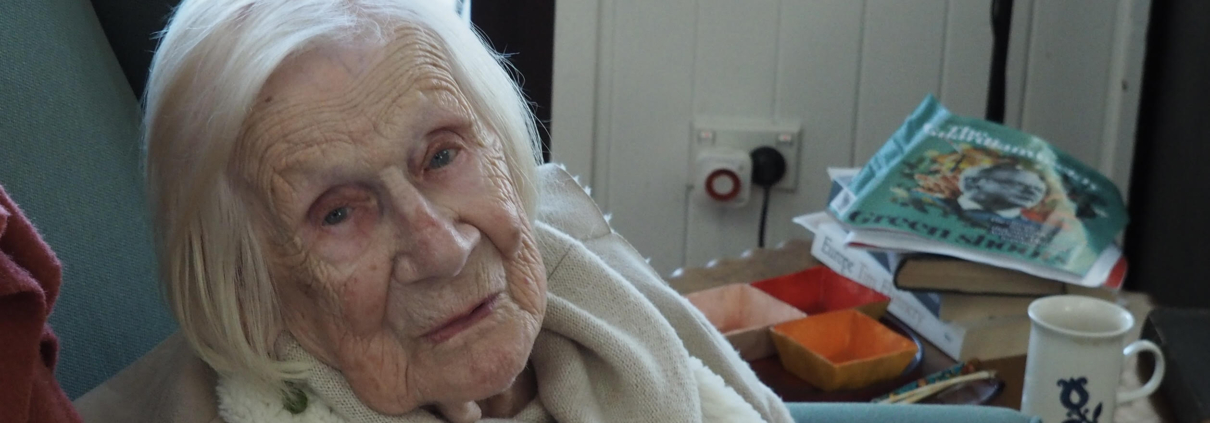
Australian IAWRT Member Lis Kirkby, a president of IAWRT in the late 1970s and early 1980s, has died at her home north of Sydney, Australia, at the age of 105.
Lis attended her last IAWRT conference in Malaysia in 2011.
She was an activist in every career that she had: as an actor, as a broadcaster, a politician, a sheep and wheat farmer and the oldest person to graduate with a Doctor of Philosophy (PhD) from the University of Sydney, at the age of 93.
Lis joined IAWRT in 1963 when she was head of talks at Radio Malaya (as it was known then) however she could not be active in IAWRT as broadcasters in Asia and Australia did not fund women who were not in high management positions to travel anywhere much, especially not overseas.
” In those days, trips to Europe paid for by the ABC were reserved for senior management; It goes without saying that in the 1960s senior management was MALE! “[i]
Like all Australian IAWRT members, Lis was self- funded and could not meet other international members personally until the 1970’s when her travel to the UK to see relatives coincided with an IAWRT conference in Brussels, Belgium.
“It was a long slow trip by air in those days. I went from Sydney with a stopover in Athens then to Brussels for the conference then London, Paris and Madrid and back via Washington, San Francisco and Fiji”.
By this time Lis was freelancing with the Australian Broadcasting Commission, where she was a producer/presenter of ‘Morning Call’. “It was designed for women at home and included news items, music, household hints and eventually, some interviews with prominent women in politics and in the arts”. Lis says she had tried to audition for a news reading role as that was what she’d done in Kuala Lumpur, only to be told: “don’t be silly nobody’s going to hear news read by a woman.” [ii]
It was a tough call for a feminist and opponent of the Vietnam War to be barred from broadcasting any political analysis.
Lis’ acting career had begun in the UK where she acted in some of the premier theatre groups of the day. During WW2 She was called up and spent three years working with the women’s branch of the British Army as an entertainer, writer and producer for Stars in Battledress. Lis says she was lucky that she was allowed to do work during the war that was later not allowed for women.
After time in Zimbabwe, her radio career began in Malaysia, where she moved for her husband’s medical posting, he was also a broadcaster on Radio Malaya (as it was then called). She gave birth to three children and the family lived through the uprising dubbed the ‘Malayan Emergency’. Lis rose to become head of the Talks and Features Unit of Radio Malaysia. Some IAWRT members including a former IAWRT President, Racheal Nakitare of Kenya, were fortunate enough to be on a tour of Kuala Lumpur with Lis in 2011:
“Liz was warm and very “energetic” every step of her life. She was such an inspiration to us all who were privileged to interact with her. I remember how graceful she was in Malaysia, sharing her time and inspiring stories”.
On that tour Lis pointed out the balcony where, in 1957, she produced the ABC/BBC radio broadcast of the handover of power from the British – represented by the then Prince Charles – Lis also pointed out the site of a theatre company she helped to establish.
Lis eventually served on IAWRT’s international board from 1972 and as President from 1976 -1980. By this time, she had left the ABC: She acted in theatre and had supporting roles in several commercially popular shows of the day. Lis’ role as Lucy Sutcliffe in the soap opera Number 96, Australia’s highest rating TV program in 1973 and 1974, had made her a household name. She was the disapproving wife of a ‘whinging Pom’ (English migrant who constantly complained about life in Australia). The episode in which it was revealed that Lucy’s (Lis’) cancer tumour was benign, proved to be Number 96′s highest-ever rated episode. Number 96 was groundbreaking, introducing controversial and taboo human experiences unheard of internationally at the time. Lis was not surprised that I was one of the many children not allowed to watch it, but she strongly believed in the power of drama.
“It’s the field of entertainment, in drama programs that show social conflict in human terms that emphasise the true tensions of western life, that we can make a significant contribution” she said.
It is no surprise that the first IAWRT conference that Lis had to co-organise with Ionka Kotzeva, the [local] board member in Bulgaria, included the theme Media and the Arts. Lis loved discovering that the western view of a spartan life behind the iron curtain was not reflected in the experiences that she had there. In general, she liked the way that IAWRT offered a way to meet and perhaps understand many other cultures through meeting women. Gunilla Ivarsson, a former president of IAWRT remembers Lis’s interest in other cultures: “She was sweet, impressive, always curious. And kind. As I remember, when we met, she had just been on a trip to Azerbajdzjan to explore the cultural life there.
Lis found IAWRT offered so much scope “It wasn’t the start of the women’s movement but because many women were getting more enthusiastic and dynamic about promoting women to all kinds of jobs, senior positions they never been allowed to hold before. The fact that wasn’t only happening in Australia, but was happening in Jamacia and in Manilla, was a great experience.”
In 1979 Lis joined Australia’s centrist party, the Australian Democrats, which was the largest minor political party of the time. She was elected to the upper house of the state of New South Wales in 1981 serving there for 17 years, before moving to the south of the state and farming wheat and sheep; she also spent five years there as a local government councillor.
Lis invited me to join IAWRT in 1993. I was a journalist and she was a politician but there was never any suspicion on my part that she wanted any political advantage from me. Our friendship grew out of a mutual respect for ethics and the rule of law, and getting the facts straight. Due to her political work, I attended more IAWRT conferences than Lis managed. However, she was close to the President Gundel Krauss Dahl (1995-2001) and remained interested in IAWRT, attending the Indian biennial in 1999 and going to her last conference in Malaysia in 2011. She also mentored younger women in IAWRT, such as Violet Gonda from the UK/Zimbabwe, who later became a President.
”I was fortunate to interact with Lis during my time on the International Board and came to know her not just as a colleague, but as a mentor and friend. Along with other veteran IAWRT leaders like Gundel, she regularly shared her wisdom and advice on IAWRT matters — always engaged, always passionate.”
Violet says Lis’ view on a proposal to change IAWRT’s name showed her as “principled, articulate, and deeply proud of IAWRT’s legacy.”
Lis’s 2006 email read: “I became a member in 1963, and I am very proud of what the IAWRT has achieved since then, to change the name now is to belittle all those years of achievement…. The suggested names have none of the dignity of IAWRT and will surely lessen our influence with the UN and other international organisations.”
Many other IAWRT members have paid tribute to Lis’s grace and energy, and as someone who was always keenly interested in new ideas and who listened closely.
It’s indicative of her extraordinary energy that she began university study in her 80’s, earning an arts degree in 2006. In 2014 she completed a PhD at the age of 93, becoming Australia’s oldest university graduate. Her thesis was on unemployment during the Great Depression, which she lived through as a child. Once again, her activism was at the forefront; a paper she delivered about her thesis was entitled ‘Should Banking be Left to the Bankers? A Comparison of the Great Depression and the Great Financial Crisis’. Her thesis was all about learning from history to relieve the burden of unemployment on the most vulnerable in society.
On her 100th birthday Lis and her family were invited to the New South Wales Parliament and the leader of the Greens party David Shiebridge paid tribute to her as forging a path for independent parties. “When I looked to the exercise of conscience there was the Honourable Elisabeth Kirkby in this place, exercising conscience, politics of principle, caring about the issues of the day; bringing issues to the chamber that neither of the major parties would do.”
Apart from her doctorate, Lis was awarded a medal in the order of Australia for her service to politics and she was granted the right to continue with the title ‘the Honourable’ for the rest of the life. However, the Honourable Doctor Elisabeth Kirkby, OAM, bothered to send an email to myself and Olya Booyar (former IAWRT President) after we visited her for lunch in January this year, asking to be forgiven for her belated thankyou note!
It’s hard to close on such an extraordinary life.
I think an Afghanistan (in exile) IAWRT member, Najiba Ayoubi, sums up this loss.
“It is truly distressing that those who upheld values and strove to make the world a better place pass away—and with their departure, the world is left diminished. They contributed so much to this world, may God grant us the ability to safeguard and honour their legacy.”
————————————————————————–
[i] Quotes from Lis’ reminiscences of IAWRT written in 2003 Voices/Pictures The Story of the International Association of Women in Radio and Television
[ii] Interview with Lis Kirkby by Nonee Walsh 2023