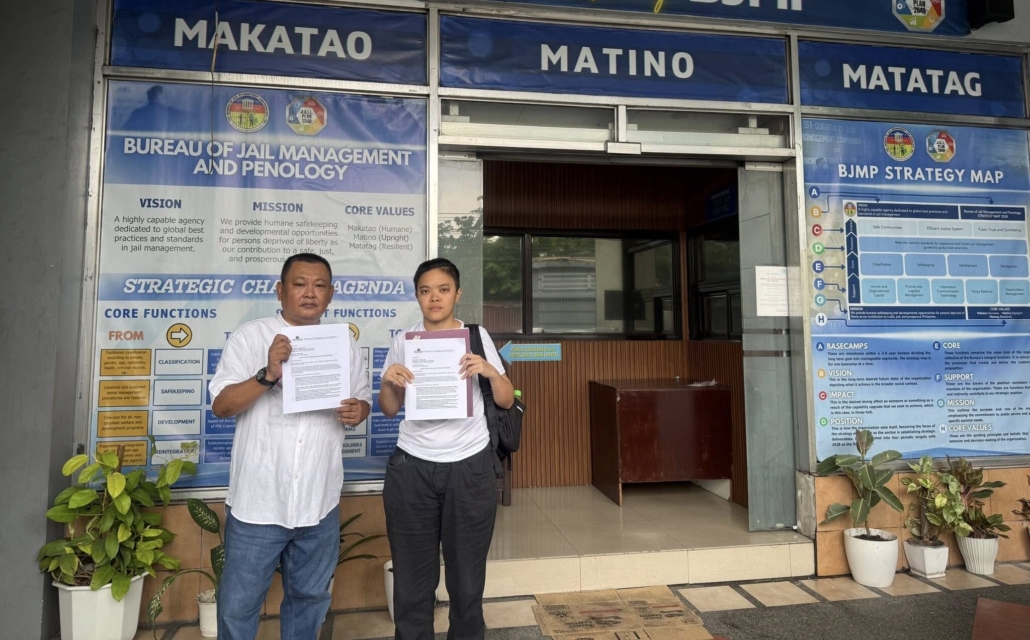
On July 16 of this year, Altermidya– People’s Alternative Media Network filed a complaint against Tacloban City Jail Warden J/Insp. Eva E. Naputo with the Bureau of Jail Management and Penology (BJMP) over alleged abuses committed against persons deprived of liberty (PDLs) — specifically Frenchie Mae Cumpio and Marielle Domequil — inside the Tacloban City Jail. The same complaint was also sent on the same day to the Commission on Human Rights (CHR) in Manila.
In a statement, Altermidya reported that Cumpio and Domequil have been subjected to “repressive treatment,” which includes denial of access to medical check-ups, and restrictions on visits from media representatives, the international community, and diplomatic missions. The complaint further alleged that letters addressed to Cumpio and Domequil were read by the jail warden but were never delivered to the intended recipients.
Photo by Altermidya: Altermidya National Chairperson Raymund Villanueva and National Coordinator Avon Ang
A week ago, it was learned that the jail warden had been replaced. However, the name of the new officer has not been disclosed, as such changes are often handled internally within the BJMP.
The International Association of Women in Radio and Television (IAWRT) expressed its appreciation for this development and hopes that the new leadership will implement policies more favorable to the rights and welfare of PDLs.
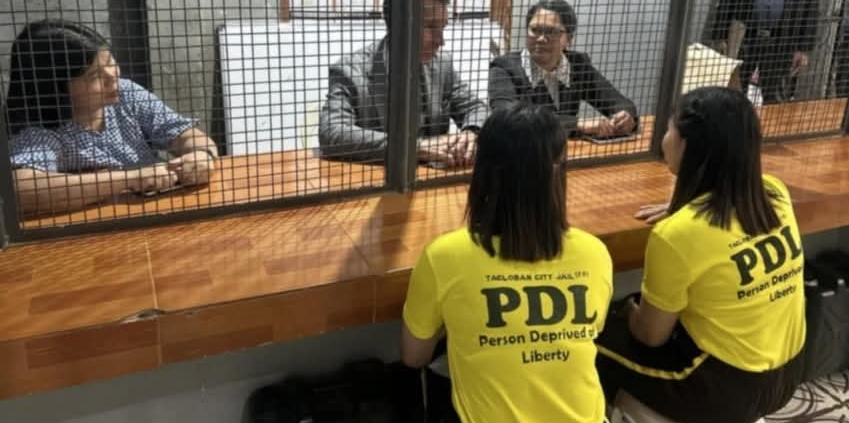
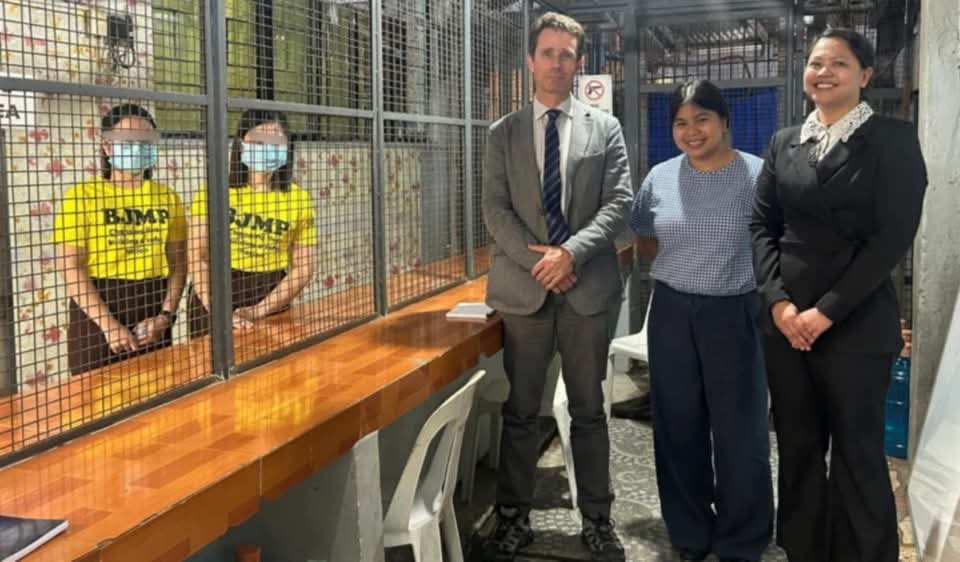
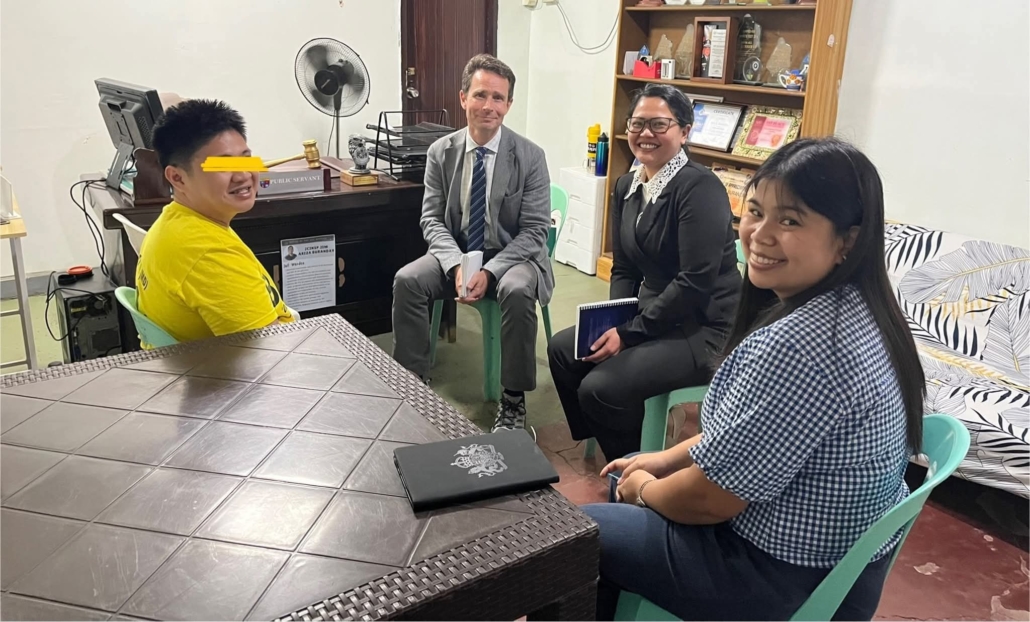
Photos from British Embassy Manila: BEM team with Frenchie Mae Cumpio and Marielle Domequil at Tacloban City Jail
Recently, it was confirmed that representatives from the British Embassy Manila (BEM) were able to visit Frenchie Mae Cumpio, Marielle Domequil, and Alexander Philip Abinguna at Tacloban City Jail.
This visit is part of the embassy’s commitment to media and press freedom and its role as a member of the Media Freedom Coalition (MFC). The embassy has expressed its intention to continue monitoring the case, which has remained in court for five years.
(Photos from British Embassy Manila: BEM team with Alexnader Philip Abinguna at Tacloban City Jail)
Cumpio, Domequil, and Abinguna are part of the so-called “Tacloban Five,” who were arrested on February 7, 2020. Two of the five have since been released on bail.
Frenchie Mae Cumpio is a community broadcaster and a member of IAWRT Philippines.
https://iawrt.org/wp-content/uploads/2025/08/draft3.jpg530849adminhttp://iawrt.org/wp-content/uploads/2021/11/logo.pngadmin2025-08-28 02:06:202025-08-28 03:39:55Frenchie Mae Welcomes Change as Jail Warden Is Replaced
In deep sorrow, the International Association of Women in Radio and Television (IAWRT) condemns the killing of Al Jazeera’s four journalists in Gaza – Anas Al-Sharif, Mohammed Qreiqeh both are correspondents together with their cameramen, Ibrahim Zaher and Mohammed Noufal. They were all killed together with Mohammed al-Khalidi and Moamen Aliwa, freelance journalist and cameraman, on August 10, 2025, in an Israeli airstrike that targeted a tent for journalists outside al-Shifa Hospital in Gaza City.
Israels attacks on journalists in Palestine are also an attack on press freedom.
This is not the first time Al Jazeera – widely recognized for its openness and commitment to truth-telling – has faced brutal attacks against its journalists.
In 2022, correspondent Shireen Abu Akleh was shot dead by an Israeli soldier while reporting in the West Bank. In 2023, video journalist Samer Abu Daqqa was killed in an airstrike. In 2024, journalist Ismail al-Ghoul and his cameraman Rami al-Rifi were both killed in an Israeli air attack. And most recently, on March 24, 2025, Hossam Shabat was also killed in northern Gaza during an airstrike.
Anas Al-Sharif, known to many for his courageous reporting on the atrocities, poverty, and bombings in Gaza, has reportedly been accused by Israel of being a member of Hamas’ military wing. The Committee to Protect Journalists (CPJ) has raised concerns about the credibility of such claims. CPJ’s Regional Director Sara Qudah said in their statement – “Israel’s pattern of labeling journalists as militants without providing credible evidence raises serious questions about its intent and respect for press freedom.” According to CPJ, 186 journalists have been killed since the start of Israel-Gaza war in October 3, 2023.
We extend our heartfelt condolences to the families and friends of those who were killed. We also express our solidarity with the Palestinian people in their ongoing suffering under Israeli occupation.
We hope that justice will be served for these atrocities, and that the voices of brave journalists in Gaza will continue to be heard. We urge the international community to listen to the stories of everyday life in Palestine and to act—not just with sympathy, but with meaningful support and accountability.
Those journalists who gave their lives will always be remembered. Their dedication to truth and justice will live on in the courage of journalists who follow their footsteps.
Josephine Karani is a name that would fill pages of a book on television production, in Kenya. Her fingerprints dot the broadcast media landscape, where she has helped shape it as a seasoned journalist, a mentor, and the current International Association of Women in Radio and Television (IAWRT) treasurer and Chairperson of IAWRT Kenya Chapter. She is indeed walking right past the glass ceilings and opening doors for many more.
It is a journey that began at the Kenya Broadcasting Corporation KBC television station 30 years ago. From scripting childrens laughter in her early works, to shaping the coverage of sports and current affairs, and later to broadcasting national debates while the head of the Parliamentary Broadcast Unit PBU, her work has been nothing but remarkable.
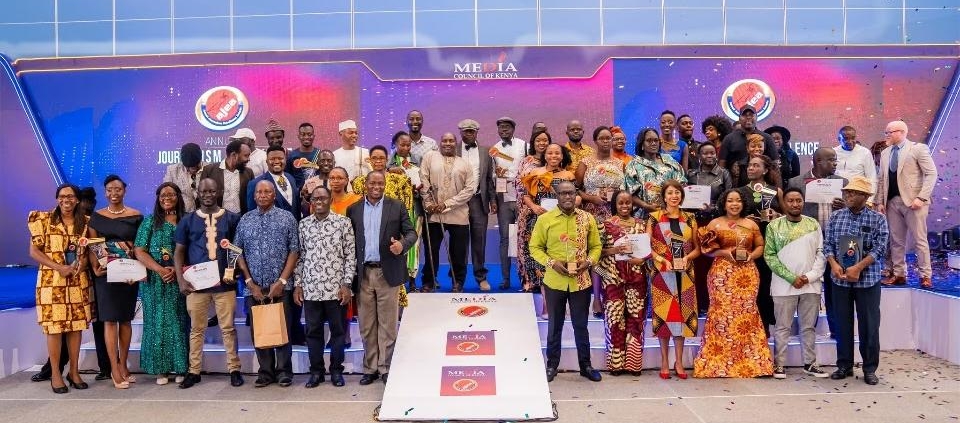
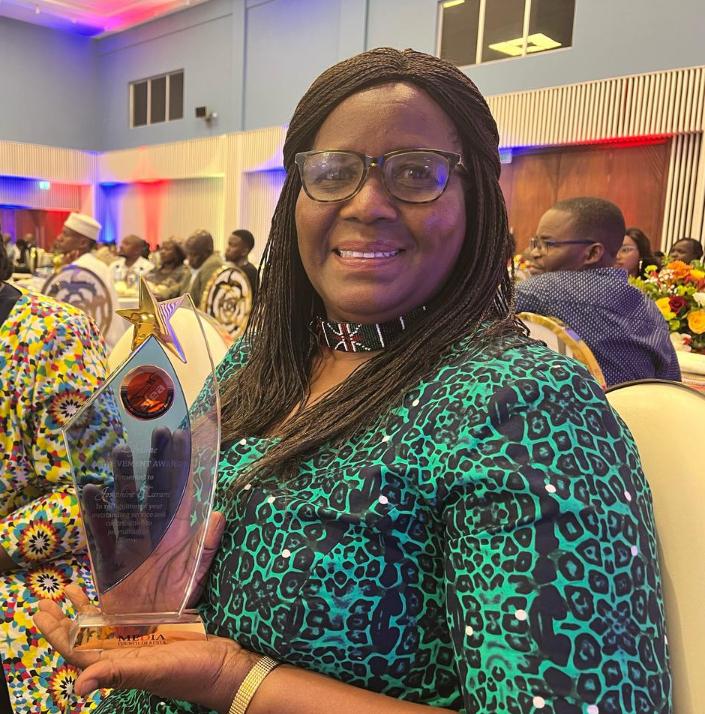
It is this decades of contribution to television production and public service that saw the Media Council of Kenya MCK fete her with the Lifetime Achievement Award. This was not just a personal accolade but a testament of the quiet but powerful legacy she has built over the years.
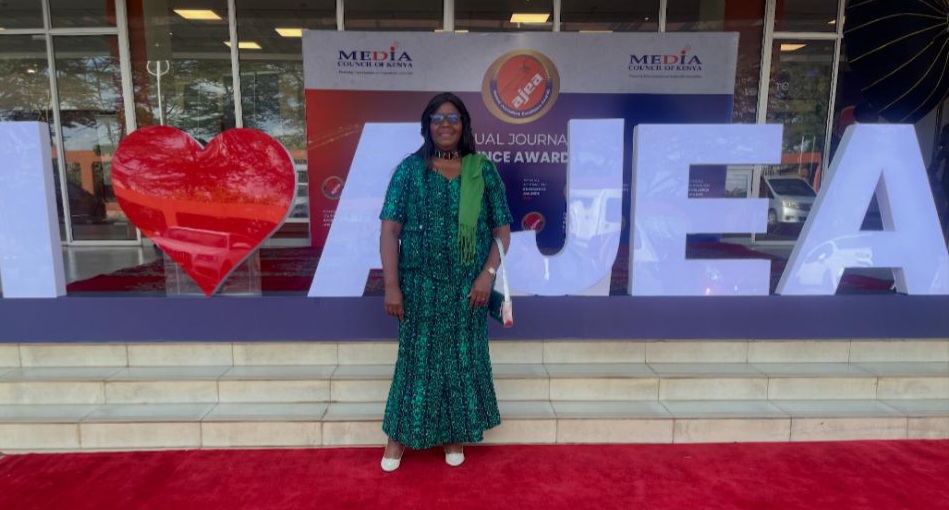
While receiving the award at the 2025 Annual Journalism Excellence Awards (AJEA) , Josephine expressed her excitement dedicating it to all women who keep pushing boundaries in the media.
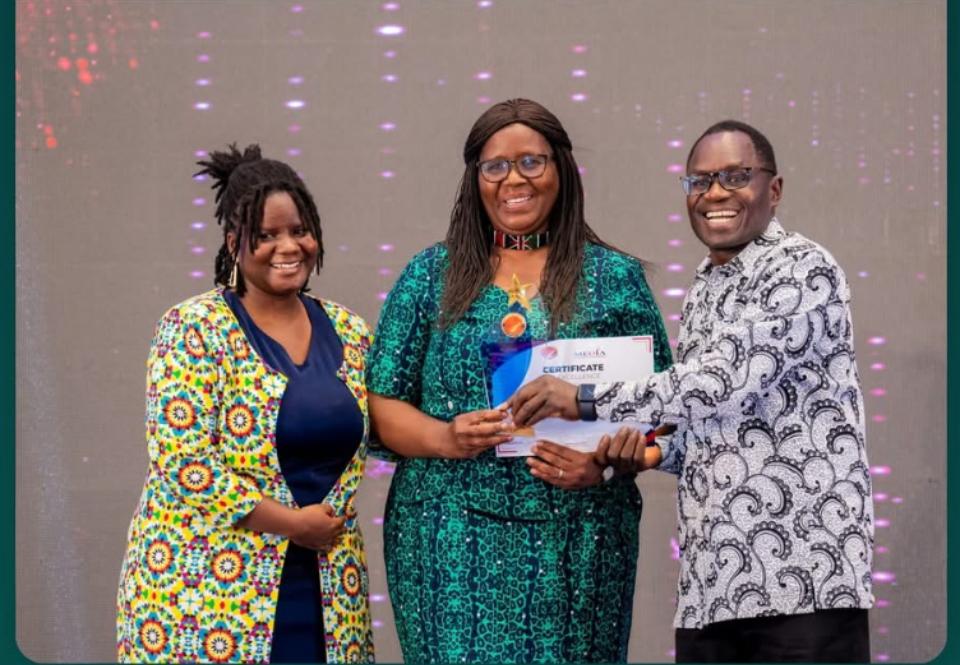
Josephine Karani, accompanied by her daughter Natalie(Journalist), receives the Lifetime Achievement Award from the Media Council of Kenya during the Annual Journalism Excellence Awards (AJEA) in Nairobi. Presenting the award is Principal Secretary ICT and Broadcasting, Stephen Isaboke.
“This award is not just for me, it is for every woman who has been told their voice do not matter. It is for every young journalist I have trained, mentored and believed in. And it is for the communities whose stories have been neglected but whose truth continues to move mountains. I am deeply honored.”
Karani’s journey is that of grit, grace and generational impact, exhibiting commitment to mentoring and growing the next generation of media professionals. Indeed, beyond the studio lights and the control rooms, she is now in the lecture hall at Masinde Muliro University of Science and Technology. Here she is shaping future story tellers, the young women,passing the baton as she helps them find their voice in the crowded, and quite challenging industry.
As she serves at IAWRT international body, she continues to champion the causes of women in media, both locally and globally. She is a steering committee member of the African Media Convention. Her leadership at IAWRT has seen over 200 female journalists from 7 public universities mentored under a US Embassy partnership. Her rich journey that has taken her from the control room , to the committee rooms of parliament, from children shows to stadia, is one that encourages women to dare to dream, lead boldly, and write their own scripts- on screen and off!
https://iawrt.org/wp-content/uploads/2025/08/1000296076-1.jpeg636960Secretariathttp://iawrt.org/wp-content/uploads/2021/11/logo.pngSecretariat2025-08-07 11:12:392025-08-07 11:12:40Josephine Karani: A Lifetime of storytelling, Service and Sisterhood!
What if doing your job puts your life at risk- just because you’re a woman speaking the truth?
For many women journalists across Africa, this is the harsh reality. From online abuse to physical and sexual threats, the profession presents real danger. This is not just for what they report, but because of who they are.
A tool that will change how the threats are documented and addressed is now here.
“We are moving from mapping to action, “ declared Racheal Nakitare, project coordinator for the International Association of Women in Radio and Television (IAWRT) at the official launch of the second phase of the IAWRT led initiative to protect women journalists.
SAFETY ON THE MAP
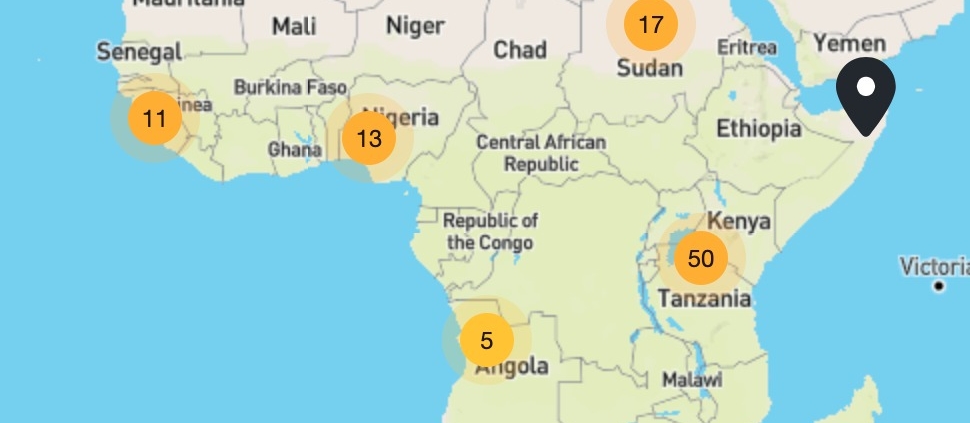
In partnership with UNESCO’s international Programme for Development of Communication (IPDC), IAWRT launched a digital platform report.iawrt.or.ke to track and report attacks against women journalists across Africa.
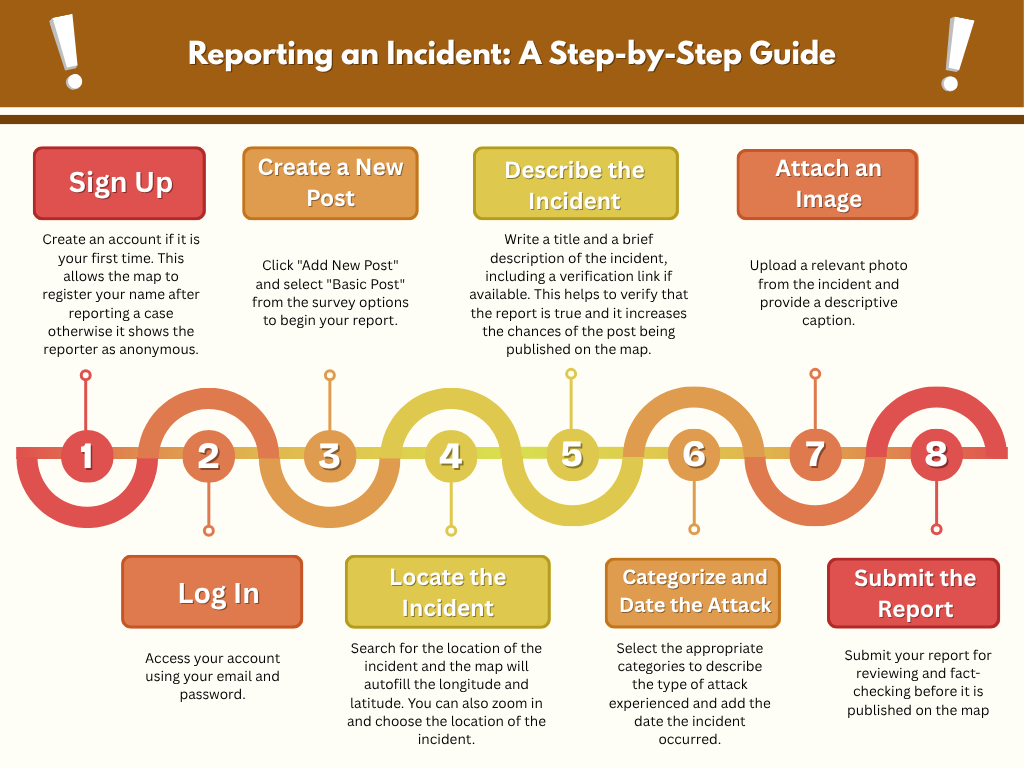
Developed with Kenya ICT network (KICTANET) and powered by Ushahidi technology, the platform allows users to log incidents in real time, tag locations and categorize threats, from harassment and censorship to physical and sexual violence.
“This map is not just a tool. It’s a call to action, said Josephine Karani, Chairperson of IAWRT Kenya.
Already over 120 stories have been documented from 16 countries, including Kenya, Uganda, Nigeria, Cameroon and Zambia.
THE THREATS IN NUMBERS
According to UNESCO’s Research on safety of women journalists:
73% have faced online violence
25% have been physically threatened
18% have been victims of sexual violence
20% of those attacked online have later been attacked offline.
“Most female journalists in Africa don’t even speak about what they go through-because of fear, lack of legal support and isolation after speaking out”, Eunice Nankwanga, a journalist from Uganda said.
The initiative is a regional force with focal points in each sub region. The participating countries are Kenya, Uganda, Tanzania, Ethiopia, South Sudan , Nigeria, Ghana, Sierra Leone, The Gambia, Zambia, Malawi, Botswana, Cameroon. The platform has regional leads for East Africa, Central Africa, West Africa, and Southern Africa.
Phase one of the project focused on the training and documentation, while the recently launched phase two is on institutional engagement.
IAWRT is now partnering with the Pan African Lawyers Union (PALU) and national enforcement agencies for evidence-based intervention.
“Despite global efforts, journalism remains a dangerous profession. Women face disproportionate threats- not only for what they report, but simply because they are women.” Said Lea Simonini, Freedom of Expression and Safety of Journalists, UNESCO Regional Office.
“Too often, these attacks are met with silence, impunity, inaction. We aim to create coordinated pathways for institutional response.” She added
Law enforcement agencies across the continent have pledged support to the initiative.
“The rights of female journalists are human rights,” said Commissioner Polycarp Ngufor of Cameroon. This project is at the heart of our work.”
Kenya’s police representative Jared Ojuok, Zambia’s Jimmy Mhango, Nigeria’s Buhari Abdullahi and Uganda’s Beyanga Cornelius among other police representatives backed the project.
ACTION
The monitoring and reporting platform is open for use. If you are a journalist or know someone at risk, help map the truth.
For years, attacks on journalists both online and offline have largely gone unreported for fear of reprisal or simply not knowing where to report. During the International Day to End Impunity Against Journalists in 2022, IAWRT Kenya and Human Rights Journalists Network -Uganda launched an initiative to combat violence against women journalists. The project’s core component in partnership with UNESCO was the creation of a crowd sourcing digital map under the banner “Applying Modern Technologies To Enhance Mechanisms for Monitoring and Reporting Attacks against journalists in Africa”. The project has had a significant impact, successfully applying emerging digital innovations to promote the safety of journalists and combat impunity for crimes against them. The initiative has also enhanced the capacity of media monitors to use modern technologies, leading to increased awareness of crimes against journalists in Africa, particularly for women in the media. Going forward, the availability of real time data on attacks will empower duty bearers, such as law enforcement and legal institutions, strengthening their role in investigating and prosecuting perpetrators.
The launch marks a pivotal moment in IAWRT’s mission to protect female journalists in Africa. By effectively mapping and documenting these cases, a robust body of data is built. This is not just a reporting tool but a powerful instrument for advocacy and change.
IAWRT-Kenya is deeply committed to the protection of women journalists and are confident that sustained and collaborative action is the path to a safer environment for professionals across Africa and beyond.
https://iawrt.org/wp-content/uploads/2025/08/IMG-20250803-WA0002.jpeg974970Secretariathttp://iawrt.org/wp-content/uploads/2021/11/logo.pngSecretariat2025-08-07 10:35:042025-08-07 10:38:24Mapping Danger: New Tool To Protect Women Journalists in Africa
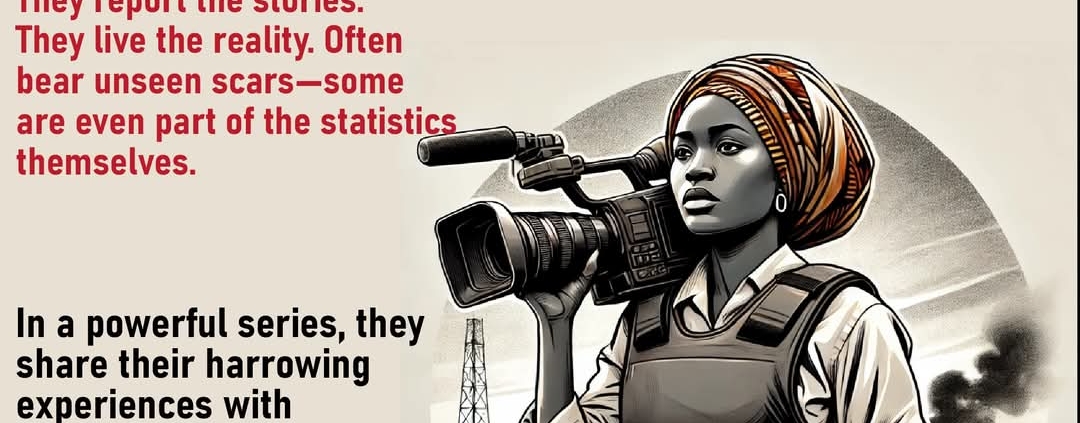
Defending the Defenders is a three-year story telling project profiling experiences of journalists who report on Violence Against Women and Girls (VAWG), and other female social justice defenders across Uganda and Africa. These “Defenders” not only amplify the suffering of survivors, but also silently carry their own psychological, Social and economic wounds.
Fourth Story
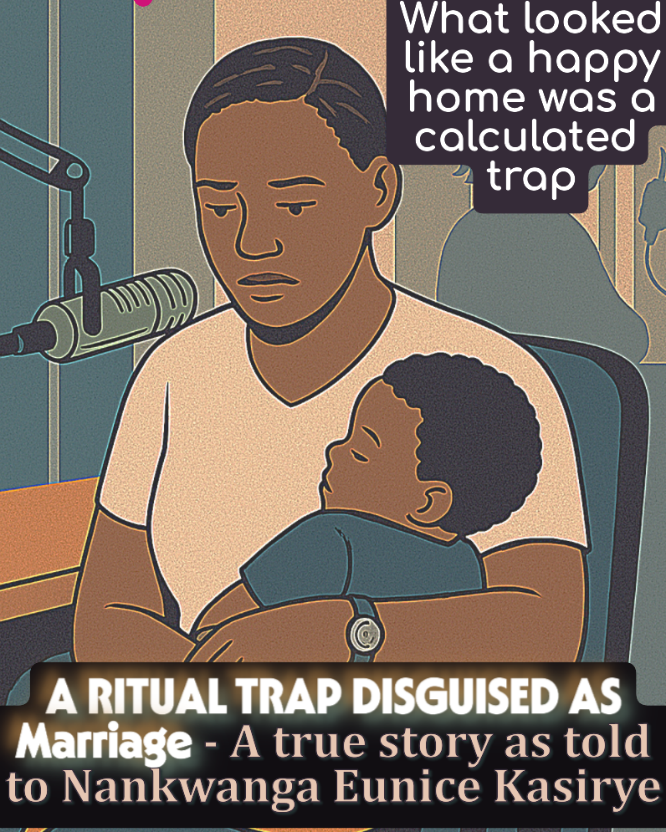
I Married a Ritualist: Joy’s Survival from a Scam Disguised as Love
Just like any other young girl fresh from college, Joy (pseudo) was vibrant, ambitious, and full of dreams. With her journalism diploma in hand, she had a mental checklist of what life should look like next: a good job, a loving husband, children, and a beautiful family. She knew exactly the kind of man she wanted—professional, respectable, someone she would proudly introduce to her parents.
Joy was the firstborn in her family, raised by Buganda cultured parents who believed deeply in marriage and all the traditions that came with it. So when she landed a job at a media house straight out of school, her life felt like it was falling perfectly into place. Amidst the busy life of a young journalist chasing stories, she held tightly to her dream of finding the right man.
Then she met him.
A tall, well-groomed, soft-spoken man—a medical doctor. The perfect picture of the man she had always dreamed of. They fell in love quickly. Everything seemed right. He was educated, polite, and ambitious. When he proposed that they make it official, Joy didn’t hesitate.
He told her his family lived abroad—his mother and sister were in the United States. That explained why she couldn’t meet them in person. But in Uganda, telling people that your fiancé’s family lives overseas often earns admiration, so Joy embraced that detail with pride. His mother and sister called her once in a while via WhatsApp, and sometimes he would hand over the phone so she could speak to them.
The traditional marriage was set. He brought a few friends and distant relatives to meet Joy’s family. Her father loved him instantly. “He was humble, handsome, and carried good genes,” Joy remembers. “I felt so lucky to have him.”
Soon after the ceremony, Joy conceived. She gave birth to a bouncing baby boy. Their life together felt full. Joy was busy, reporting on women and children’s stories —particularly around domestic violence and abuse. The job came with risks, and soon, the strange calls started.
First, they were threats from anonymous people warning her to stop covering certain stories. Then came blackmail with requests for money to stop the harassment. Her husband always stepped in, called back, and made the problems disappear. He told her not to worry.
But the calls didn’t stop. They escalated. Men claiming to be security officers said they were watching her. They knew where she was at every moment. It scared her. Her husband urged her to cut off old friends, warning that jealousy might be the root of the problem. Maybe someone from work was behind it all, he said.
Joy began isolating herself. The calls were too accurate—they knew everything. She stopped receiving calls from family and friends. Even those who used to visit now avoided her. The silence was deafening. Her only companions became her husband and her ever-online mother-in-law, checking in daily from “abroad.”
She started doubting everyone at work. She shrank her world down to just her husband and child. And then, just as she was adjusting to that new, lonely life, her husband suggested they do a church wedding. He said people were jealous of their happiness it should not be made so public. Joy agreed. She would do anything to make their marriage work.
But before they could even finalize the wedding plans, her husband disappeared.
A stranger called using his phone. He said the doctor had been kidnapped. Unless Joy paid a ransom, her husband would be killed. Her mother-in-law called her, panicked. The kidnappers said the ordeal was punishment for something Joy had done. She was thrown into a state of panic.
This time, there was no one to lean on. The man who had always stepped in to “fix things” was now the one in danger. The kidnappers later claimed to be working for her husband’s bitter ex-girlfriend, who wasn’t ready to let go. She accused Joy of stealing her man and trying to seal it with a church wedding.
Joy sent money. Her mother-in-law, coordinating everything from abroad, claimed to be in contact with “security.” Eventually, her husband was released. But Joy never recovered. She was mentally exhausted, emotionally drained, and physically worn down. She lost appetite, focus, weight. Work became a blur.
Just as she was trying to pull herself together, the phone rang again.
This time, it wasn’t threats. It was an arrest warrant. She was being accused of murder—of killing the same ex-girlfriend. Evidence was “pointing directly” at her. Joy broke down completely. She attempted suicide—twice.
Then one day, her father saw her reading the news on TV. He noticed something was terribly off. Her face looked hollow. Her eyes looked lost. He called her brother and asked him to check on her.
When her brother came to visit and listened closely to everything Joy was going through, he decided to quietly take her phone and kept it for a day, just to break the cycle.
Later that evening, when Joy got home, her husband seemed unusually anxious. He asked why she hadn’t been answering his calls all day. She calmly replied that she had misplaced her phone during her busy schedule and hadn’t had it with her.
But then he said something that stopped her in her tracks—he mentioned the exact location of her phone.
Joy was stunned.
When she later asked her brother if the husband had called, he shook his head. No calls had come from the husband’s number. Only the same unknown, threatening numbers that had been haunting her for months.
That’s when it began to sink in.
That’s when it hit her. Everything had been staged. All the terror—the threats, the fake kidnappings, the murder accusations—they had all come from him.
She remembered how every time she thought of reporting to police, a call would immediately come warning her not to. She had always believed it was some outside force. But now, it was clear: he was the force.
Still, Joy tried to forgive. She wanted to believe it was all a misunderstanding. Her mother-in-law, always calm, always online, encouraged her to focus on rebuilding the trust.
Then, the final blow.
One day, her husband dozed off on the couch. Joy wanted some small change to buy items from the nearby shop. She quietly picked his wallet—and froze.
Inside were skeletons of birds. Pieces of reptiles. Tied pieces of bark cloth. Pieces of clothes cut from her different nickers bound together in a knot with the rest of the items.
She trembled.
She didn’t know what to say, how to react. Fear engulfed her. She was living with a complete stranger, that she was sure …
Then, just days later, her “mother-in-law” called on WhatsApp, saying she couldn’t reach her son and wanted to talk to him through Joy’s phone. He was asleep in the bedroom and joy preparing a meal in the kitchen. Joy took the phone to him. They talked.
When he returned the phone, he went back to the bedroom. Just a few moments later, a WhatsApp message came in.
It was from the same woman. She had forgotten she had used Joy’s phone. The message was full of instructions to her “son” about how to conduct a ritual—using Joy and their child.
That’s when it became clear.
The woman wasn’t his mother. She was a witchdoctor. There were no relatives abroad. There was no family in America. The man Joy had called her husband was not who he said he was. The marriage, the love, the dreams—they had all been part of a ritual scheme. All the friends and distant relative he had gone with for traditional were fakes, people hired for that particular function-
Joy didn’t scream. She didn’t fight. She packed her bags. She took her son.
And she left. That was five years ago. She never looked back.
Joy still becomes anxious while telling her story- she is yet to gain complete healing –that Road to healing is rough as well
https://iawrt.org/wp-content/uploads/2025/06/Uganda-Eunice.jpeg10131080Secretariathttp://iawrt.org/wp-content/uploads/2021/11/logo.pngSecretariat2025-08-07 09:18:592025-08-07 09:19:01DEFENDING THE DEFENDERS

![From left: Anas al-Sharif, Ibrahim Zaher, Mohammed Noufal and Mohammed Qreiqeh [Al Jazeera]](https://iawrt.org/wp-content/uploads/2025/08/1000044491-4-1754998864-1170x423.webp)