
IAWRT Uganda Chapter
Post-Activity Report
Virtual Engagement on Artificial Intelligence and Journalism
Date of Activity: May 4, 2025
Platform: Zoom
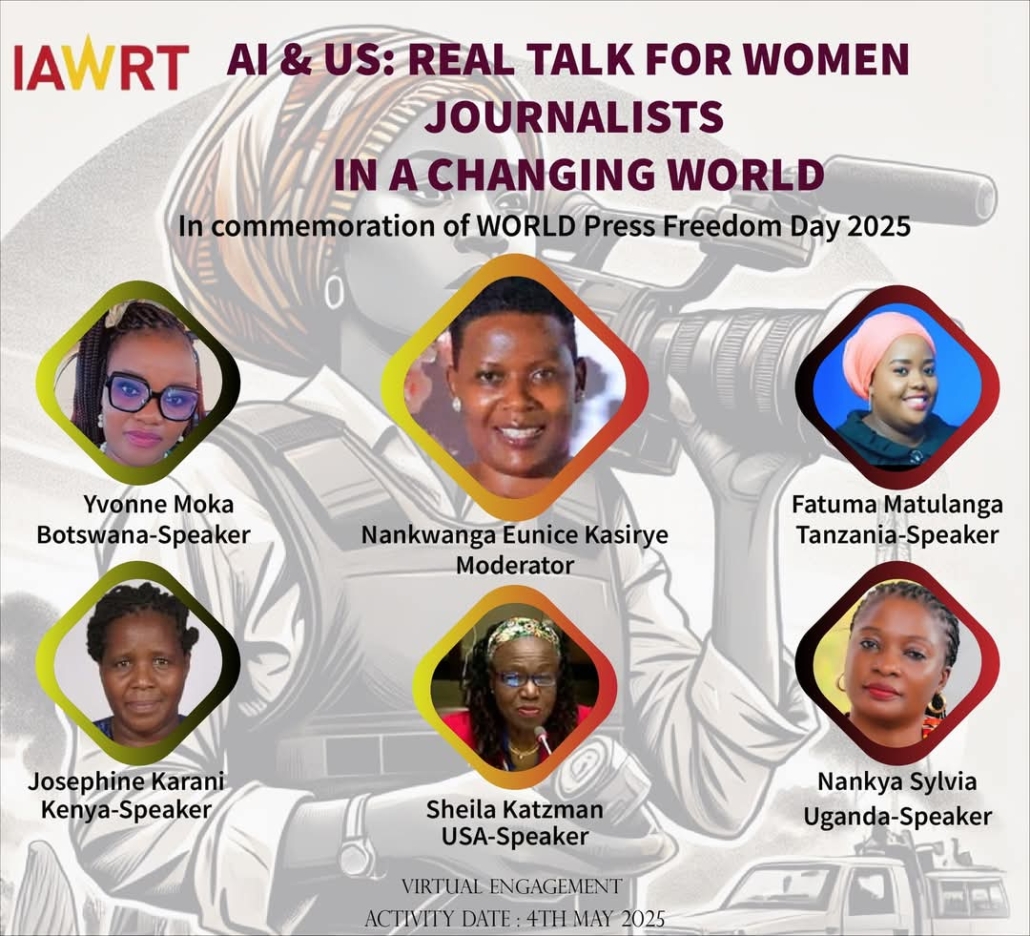
Theme: “AI & Us: Real Talk for Women Journalists in a Changing World” Prepared by: Nankwanga Eunice Kasirye DateofReportSubmission:May10th 2025
1. Introduction
This post-activity report provides a detailed account of a virtual engagement hosted by the Uganda Chapter of the International Association of Women in Radio and Television (IAWRT) on May 4, 2025. The event was part of a broader continental conversation commemorating World Press Freedom Day, under the global theme “Reporting in the Brave New World: The Impact of Artificial Intelligence on Press Freedom and the Media.”
IAWRT Uganda localized the conversation under the theme “AI & Us: Real Talk for Women Journalists in a Changing World”, aiming to explore the current realities, knowledge gaps, challenges, and potential solutions regarding AI in journalism from the perspective of African women journalists.
The event emphasized practical engagement, regional knowledge sharing, and collaborative learning, with the goal of positioning women journalists as both subjects and agents in the global AI discourse.
2. Objectives
- To unpack what artificial intelligence means in real life for women journalists with limited resources and opportunities.
- To explore how AI can both threaten and possibly support women’s survival, voice, and growth in media.
- To give women in media a space to learn, speak freely and strategize across borders.
3. Participation
- Over 40 participants from Uganda, Kenya, Tanzania, Nigeria, Botswana and the USA attended the session, including editors, media trainers, researchers and digital rights activists. The session was conducted via Zoom and featured cross-generational and cross- disciplinary interactions that fostered learning, reflection and solidarity.
4. Session Highlights and Key Speaker Insights
Moderator’s Remarks
NANKWANGA EUNICE KASIRYE – CHAPTER HEAD, IAWRT UGANDA
Nankwanga Eunice Kasirye, convened and moderated the engagement. She opened the session with a reflection on the importance of World Press Freedom Day and the shifting dynamics of journalism in the AI era. She also underscored the multiple barriers that African women journalists continue to face, including:
- Low or no pay for journalistic work.
- Limited access to appropriate digital tools and AI technologies.
- Unreliable, costly internet connectivity and electricity infrastructure.
- Scarce professional development and training opportunities.
According to UNESCO, over 45% of journalists in sub-Saharan Africa work without regular pay, while only 28% of women in the region are online. The International Telecommunication Union (ITU) further notes that only 19% of women in least developed countries have internet access, compared to 31% of men—highlighting a persistent digital gender divide.
In her remarks, Eunice stated: “As African women journalists, we recognize that no one is coming to save us. We must train ourselves, pool our sources, and build the skills to navigate AI. This is how we reclaim power: by telling our own stories and shaping our own narratives.”
The engagement offered an important space for reflection and solution-building, reaffirming the need for African women to be at the forefront of shaping ethical, inclusive AI tools and practices in journalism.
JOSEPHINE KARANI – CHAPTER HEAD, IAWRT KENYA
Topic: Low-cost AI tools that help women work smarter
Josephine emphasized the transformative potential of Artificial Intelligence in journalism, particularly its ability to improve newsroom efficiency through tools for transcription, editing, translation and data analysis. However, she cautioned against the unchecked adoption of AI technologies without robust ethical frameworks to guide their use.
She pointed out that the high cost of AI tool subscriptions and the urgent need for training and upskilling remain major barriers for African journalists. Many are already struggling to access basic online training and essential digital tools, making AI adoption even more challenging.
Josephine stressed that while AI can automate certain tasks, the quality of its output depends entirely on the quality of input it receives. “Garbage in, garbage out,” she warned. For female journalists, especially, this means that strong foundational skills are essential. AI can enhance presentation, improve delivery speed and accuracy—but the core of storytelling must still come from the journalist.
Given that AI is emerging at a time when skill gaps and access to credible tools are still significant for many African women journalists, risks such as plagiarism, content manipulation and data misuse are heightened. Josephine emphasized the need for continuous training and reskilling, urging for greater involvement of African women in the development of AI tools. This, she noted, is crucial for safeguarding data, controlling narratives and ensuring that technology reflects African realities.
SHEILA KATZMAN – CHAPTER HEAD, IAWRT USA
Topic: Centralizing Journalists in AI Ethics
Sheila acknowledges that AI is here to stay—it simplifies data analysis, storytelling and editing—but it can never replace the human empathy and courage behind powerful journalism.
While AI poses real threats to jobs, with automation already replacing roles in some parts of the world, especially in the West, she insists that women journalists must not be left behind. She emphasises the need to actively seek training, participate in the design and development of AI tools, and ensure safety, perspectives and interests are embedded in this technological
evolution.
“Let’s take advantage of free, credible training opportunities—like those offered by IBM— while they’re still accessible.” Sheila re-emphasised
SYLVIA NANKYA – JOURNALIST AND MEDIA TRAINER, UGANDA
Topic: Practical Benefits and Challenges of AI Use
Sylvia shared her personal journey from initial skepticism to the creative and strategic use of AI in her work. She highlighted how AI has significantly enhanced her workflow, particularly in the areas of research and audience targeting. Sylvia emphasized the value of AI in improving timeliness, noting that it helps overcome the delays typically associated with traditional methods of filing stories and conducting background research. However, she underscored that the core responsibility for authorship remains with the journalist. According to Sylvia, relying solely on AI without proper oversight can lead to distorted information and misinformation. She stressed the importance of journalists drafting their initial versions and rigorously verifying AI-generated content.
Reflecting on her first encounter with AI, Sylvia recalled a moment when, as Editor-in-Chief at the Uganda Radio Network, she needed to prepare
news scripts and design a flier for a client but had no reporters available. Turning to AI, she was impressed by the quick and effective results it delivered, especially in a time of limited human resources.
Sylvia concluded by reiterating that while AI is a powerful enabler, it must be used with caution. She advised users to carefully read and understand the terms and conditions of any AI tool before adoption, as these vary across platforms.
YVONNE MOKA – SOCIAL JUSTICE JOURNALIST, BOTSWANA
Topic: Online Safety and Abuse of Women Journalists
Yvonne Moka offered a deeply personal and powerful reflection on the escalating threats women journalists face online—particularly those who report on sensitive topics like violence against women and girls.
She began by painting a picture of the media environment in Botswana, where technological change is often met with cultural caution. AI is still seen as something distant, even suspicious. Yvonne clarified that the pace of adoption is slow, not just because of limited access, but due to widespread skepticism about new innovations— especially those tied to technology. This hesitancy, while understandable, leaves many media practitioners lagging behind in leveraging AI tools for their work. Yet ironically, the very people with malicious intent have already embraced these technologies to target journalists with abuse.
As someone who works with several international media outlets, Yvonne often uses digital platforms and tools to execute her assignments. That constant online presence makes her more visible—and more vulnerable. She recounted how she’s repeatedly been targeted with online trolling and abuse for her reporting on gender-based violence. It doesn’t stop at the screen, some of the insults followed her into her home. People she thought would protect her started repeating those same words, breaking her even more.
Her testimony was a sobering reminder that online abuse is not abstract—it’s intimate, invasive and traumatic. For Yvonne, the cost of doing her job has often meant personal harm, emotional distress and professional isolation.
She emphasized the urgent need for systemic protection, calling for institutional mechanisms—not just individual coping—to address AI-fuelled abuse. “It’s not enough to tell us to be strong,” she insisted. “We need clear digital safety protocols, trauma- informed responses and policies that actually protect women journalists—especially those on the frontlines of truth-telling. We cannot fight AI-driven abuse with silence. We need policies and protections, not just resilience.”
FATUMA MATULANGA – CHAPTER HEAD, IAWRT TANZANIA
Topic: Digital Literacy and Resources
Fatuma highlighted the infrastructural and knowledge gaps affecting women journalists in rural and underserved areas. She presented an ongoing initiative to equip 28 press clubs in Tanzania with digital labs.
There is an existing technological gap among African women journalists, rooted in limited resources, lack of digital skills, poor access to electricity and the internet and unavailability of appropriate tools. These structural challenges continue to leave female journalists behind in the digital revolution. To close this gap, we must leverage the few available enablers and advocate for systemic support.
Improving the capacity of individual women journalists requires pushing for minimum wage policies from central governments, pooling resources to create shared learning centres with internet access and promoting the collective use of tools and equipment. This approach fosters a collaborative growth model that ensures no one is left behind.
By holding each other’s hand and embracing diversity as African women in journalism, we can learn from each other—like in Tanzania, where despite limited resources, there are public journalism centres and minimum wage guarantees. This collective spirit can drive towards a more inclusive and empowered media landscape.
5. Key Issues Raised
- AI literacy remains low among African women journalists.
- AI tools are not always accessible, culturally relevant, or ethically guided.
- Gendered online violence is exacerbated by AI-driven content manipulation.
- Lack of editorial oversight and overreliance on AI tools threatens journalistic integrity.
- Structural inequalities (economic, geographic and digital) hinder inclusive participation in the AI ecosystem.
6. Recommendations and Action Points
Stakeholder Recommendation
IAWRT Global Leadership Develop policy papers on AI, journalism ethics and gender inclusion.
IAWRT Chapters Host periodic learning sessions on AI tools, safety and storytelling innovation.
Media Institutions Integrate AI ethics and literacy into newsroom practice and training.
Journalists Enrol in free AI courses (e.g. IBM Skills Build, Coursera) and practice safety.
Donors & Partners Fund local innovation labs and rural journalism training hubs.
Regional Networks Develop cross-border digital safety protocols and mentorship programs.
7. Outcomes and Next Steps
Immediate Outcomes
- Stronger inter-chapter collaboration within IAWRT Africa.
- Increased interest in AI learning among women journalists.
- Actionable proposals for continued digital empowerment and storytelling innovation.
Next Steps
- Share AI Learning Resources: Distribute curated links to free courses and tools.
2. Organize Follow-Up Webinar: Focus on AI misinformation and content verification.
3. Develop Advocacy Paper: Draft a continental position paper on AI and journalism.
4. Establish a Resource Hub: Begin consultations on a shared AI knowledge and learning portal for African women journalists.