Section J of the Beijing Declaration: Gains and Reversals
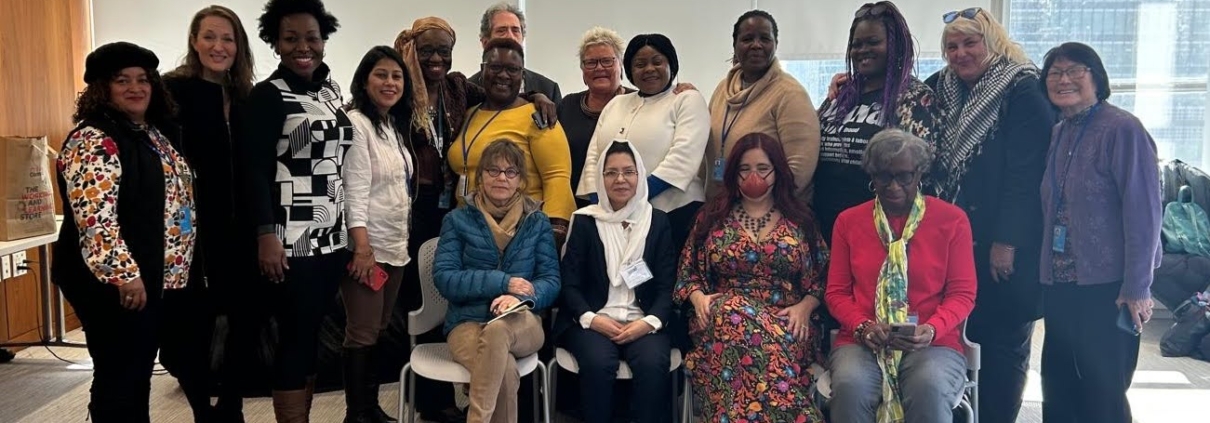
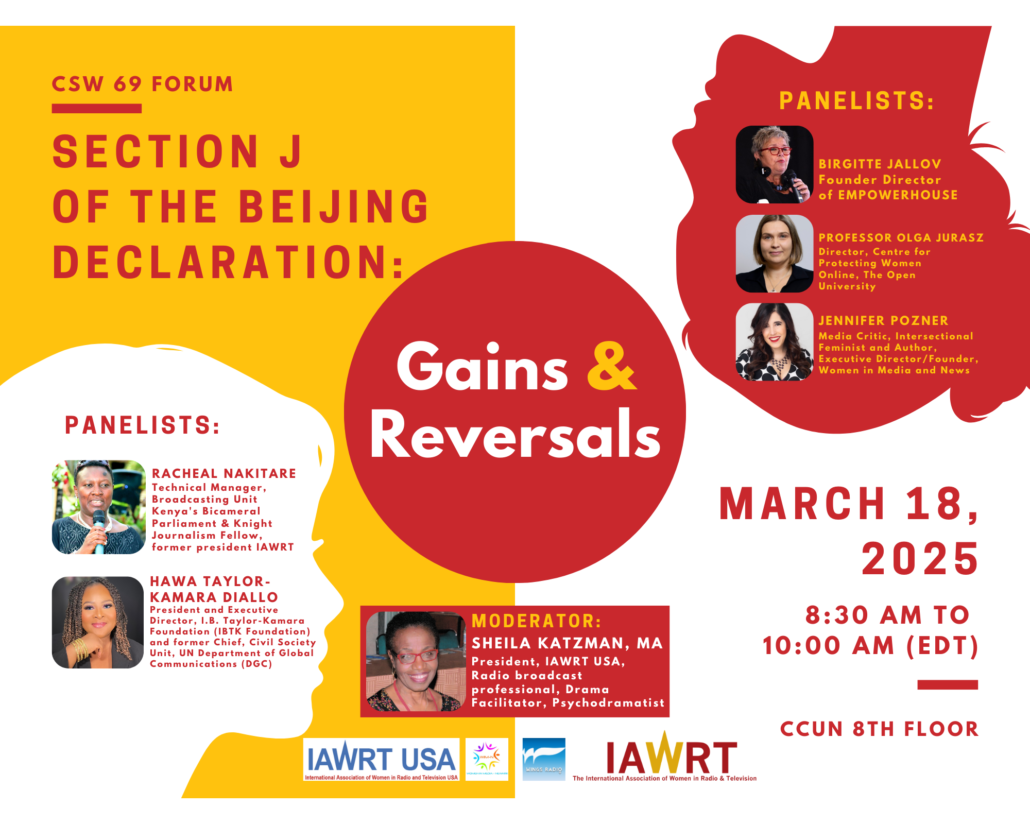
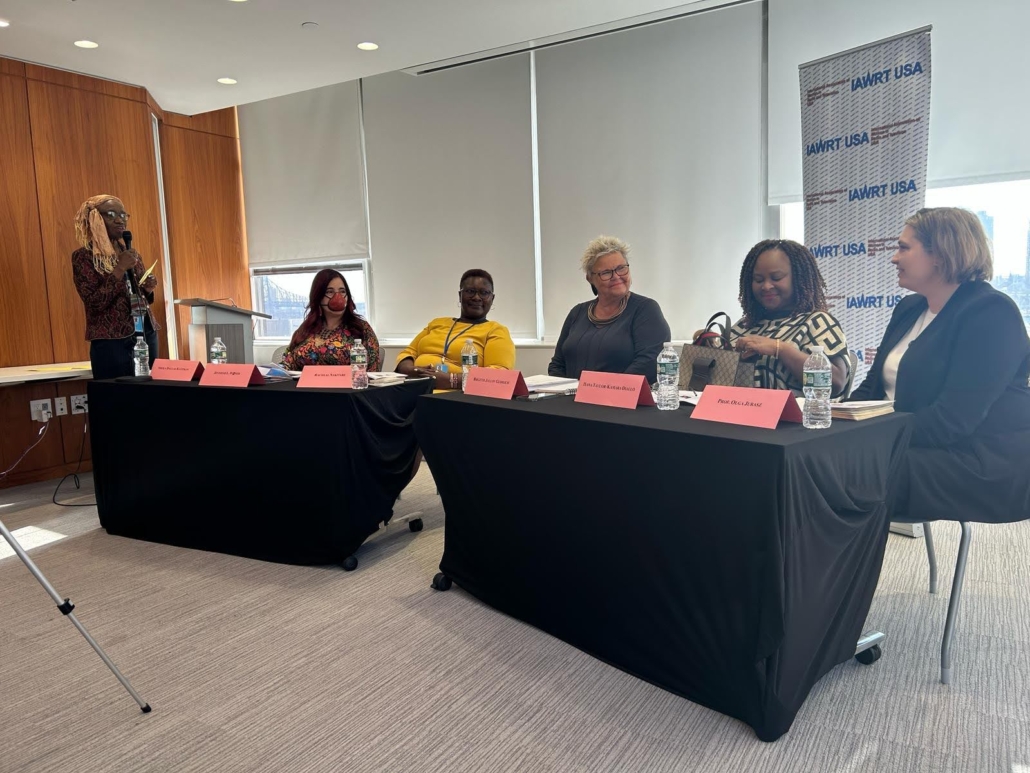
This thought-provoking parallel session, on March 18, 2025, organized by IAWRT USA, had on the panel Birgitte Jallov, Prof. Olga Jurasz, Jennifer Pozner, Racheal Nakitare and Hawa Taylor-Kamara Diallo, and was moderated by Sheila Katzman.
In 1995, in Beijing, proactive media women – including a number of IAWRT’s veteran members like Frieda Werden – worked together to bring in the section J within the Beijing Declaration, focusing on ensuring a proper representation at all levels of women in the media – and an appropriate portrayal of women in the media, regarding the media not only as channels, but as important feminist platforms, not only for expression but also for interpretation of ‘the world’ through the eyes of women – for women and all other genders.
So, on March 18, the panelists, representing important perspectives within and around the media, met to take stock of section J of the Beijing declaration focusing on ‘women and media’. In their review they focused on gains and reversals – covering the broad spectrum from women’s role in the media and portrayal of women, over AI and SoMe and its effect on women in and outside the media and on to the transformatory potential of community media in women’s lives.
The panel was well attended, both physically and virtually, by IAWRT members and many others concerned with the role of women in the media.
https://iawrt.org/wp-content/uploads/2025/06/csw69-photo2.jpeg7891301Secretariathttp://iawrt.org/wp-content/uploads/2021/11/logo.pngSecretariat2025-03-20 18:00:002025-06-02 07:33:47IAWRT Parallel Event for CSW 69
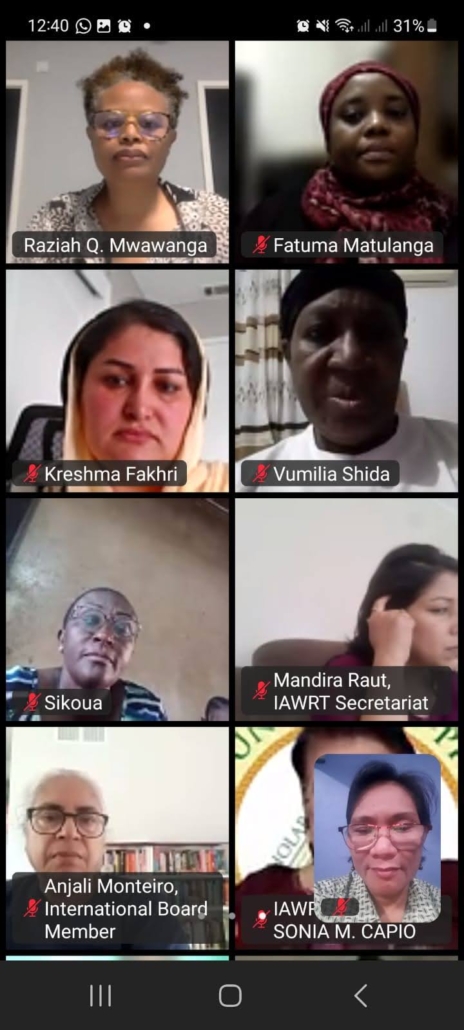
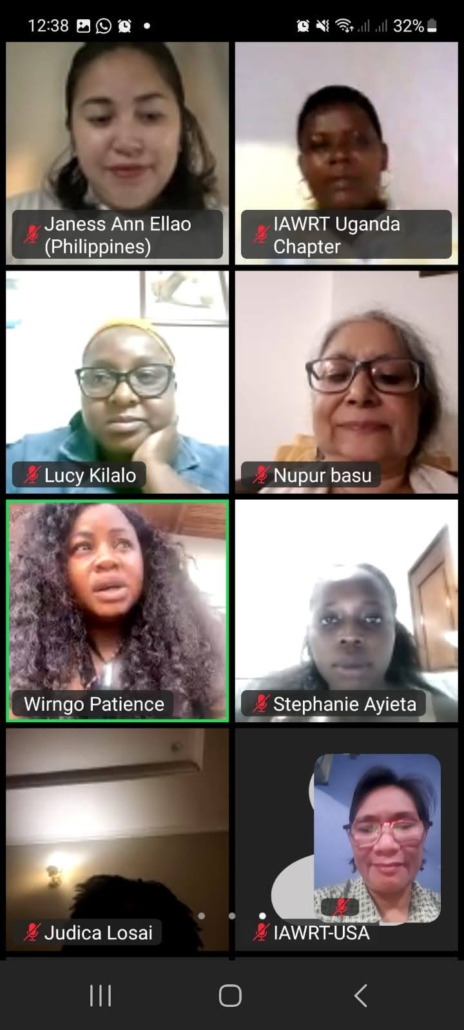
On the occasion of International Women’s Day, IAWRT International organised a virtual seminar on the theme ‘Urgency for Women Journalists’ Safety and Security’ on 15 March 2025. The focus was on the pressing need to enhance safety and security for women journalists worldwide. The objectives included:
Analysing and reviewing current country-specific and global safety challenges.
Discussing sustainable solutions to accelerate safety and security.
Identifying legal, policy and institutional barriers to progress.
Identifying country specific best practices and interventions that can be replicated.
Participants comprised IAWRT global members, chapter heads and stakeholders from the media sector. Presentations were made by Kenya, the Philippines, Tanzania, Uganda, Cameroon, Afghanistan, Nepal, India and the United States chapters, who presented national perspectives and potential solutions.
Opening Remarks The meeting was moderated by Raziah Quallatein Mwawanga, IAWRT International Board Member, who organised and facilitated the proceedings. She welcomed participants and provided a sobering context for the discussions, noting that while progress had been made towards gender equality and journalist safety, the World Economic Forum estimates it would take five generations to achieve full gender parity at current rates of progress. She emphasised that women journalists could not afford to wait that long for their fundamental rights and safety to be realised and stressed the urgent need for proactive collaboration, peer learning and implementation of best practices to accelerate progress in closing the safety and security gap.
In her opening address, President Jola Mamangun outlined the precarious safety situation facing women journalists globally, citing specific cases of imprisoned journalists in the Philippines and severe restrictions under Taliban rule in Afghanistan. She emphasised the critical need for international solidarity and immediate action to address violence against journalists and support those at risk.
Keynote Presentation: IAWRT-Kenya’s Monitoring & Reporting Programme Josephine Karani (Head of IAWRT-Kenya and International Board Treasurer) made a presentation on the Monitoring and Reporting Violations on Safety of Journalists Programme, which was established to combat impunity for crimes against journalists in Africa, with particular focus on women. This initiative commemorates the 10th anniversary of the UN Plan of Action on Safety of Journalists, utilising a digital mapping tool (IAWRT Violations Map) to systematically document attacks.
Key achievements include the training of 14 journalists across five African regions to undertake documentation. They have documented 116 verified cases including physical assaults, intimidation and threats, online harassment and disinformation campaigns, arbitrary arrests and detentions and economic coercion and censorship.
The interactive mapping system has proven as an effective data collection evidence advocacy tool for policy reform and accountability measures.
Country Safety Profiles & Best Practices Representatives from nine IAWRT chapters presented detailed analyses of national safety conditions, challenges and successful initiatives. These are summarized below:
A. Success Stories & Best Practices
1. Kenya (Josephine Karani)
o Implementation of digital monitoring system (IAWRT Violations Map) for documenting attacks
2. Tanzania (Fatuma Matulanga)
o Establishment of Tanzania Journalists Accreditation Board to enhance professionalism
3. Nepal (Manita Pokharel)
o Elimination of mandatory journalist registration requirements
o Introduction of workplace breastfeeding facilities
o Mandatory 33% gender inclusion quota for all participant events
B. Key Challenges
1. Afghanistan (Kreshma Fakri)
o Severe repression of female journalists under Taliban regime
2. Uganda (Eunice Kasirye)
o Lack of professional solidarity and brutality against journalists exacerbating vulnerability
3. United States (Sheila Kazman)
o Erosion of public trust in journalism
o Persistent gendered violence in the media sector
C. Opportunities for Action
· Philippines: Mobilisation of international pressure for jailed journalist releases
· India: Strengthen legal protections against online harassment, spying and vandalism on journalists and their equipment
D. Strategic Priorities
· Policy and legal reforms to combat impunity
· Increased funding for safety training programmes
· Adoption of monitoring technologies for evidence-based advocacy
E. Sustainable Strategies to Accelerate Action
· Enhanced monitoring systems for accountability
· Implementation of gender-sensitive policies
· Industry-wide improvements to journalists working conditions
· Data-Driven Advocacy: Use of real-time monitoring tools (IAWRT Violations Map) to hold perpetrators accountable.
· Criminalize and enforce laws and punishment for perpetrators of online harassment and threats against women journalists.
· Media Industry Reforms: Improve working conditions (contracts, timely payments, safety protocols).
· Promote solidarity networks to boycott abusers and support victims.
F. Call to Action
· Governments to enforce journalist protection laws, Ratify and enforce laws protecting journalists (UN Plan of Action).
· Media organisations to implement and adopt zero-tolerance violence; and harassment policies
· International bodies to increase funding for safety initiatives
· International Bodies (UN, UNESCO): Amplify funding and advocacy for journalist safety.
G. Conclusion Despite country, regional and global progress, women journalists continue to face disproportionate risks of violence, discrimination and systemic neglect. Addressing these challenges requires:
· Robust accountability frameworks across legal and policy spheres
· Adoption and replication of existing best practices the likes of Tanzania, Nepal, Philippines
· Increased inter Country, Regional and International cooperation to share effective best practices, laws and policies solutions
· Sustained global advocacy to maintain focus on women journalists safety and security to Accelerate Change and Urgency
The discussions underscored the necessity for coordinated action among governments, media institutions, stakeholders, the public and international organisations to implement and reinforce measures effectively. Without such commitment, the fundamental rights and safety of women journalists will remain under threat, with significant consequences for press freedom and gender equality worldwide.
https://iawrt.org/wp-content/uploads/2025/06/MARCH-15-IAWRT.jpeg230512Secretariathttp://iawrt.org/wp-content/uploads/2021/11/logo.pngSecretariat2025-03-18 19:00:002026-05-19 02:20:10IAWRT International Women’s Day Celebration
Overview In the first quarter of 2025, the India Chapter of the International Association of Women in Radio and Television (IAWRT) successfully organized four major activities that showcased its continued commitment to fostering women’s voices in media and the arts. These included the Young Directors’ Workshop, a film competition celebrating women artists, a panel discussion on Women and the Arts, and the milestone 20th edition of the Asian Women’s Film Festival (AWFF).
Young Directors’ Workshop (Feb 10–15, 2025) In partnership with: Delhi Tourism Location: Delhi Participants: 25 young women from urban slums, in collaboration with Yellow Streets
This intensive week-long workshop was designed to train young women community journalists in the fundamentals of cinematic language and editing. Facilitated by filmmakers Samina Mishra and Nundrisha Wakhloo, and supported by student mentors from Bennett University, the participants explored themes of freedom, friendship, sadness, and joy through practical filmmaking exercises.
Workshop highlights:
· Focus on visual storytelling, mise-en-scène, editing, and sound design.
· Short films produced during the workshop were screened at the opening ceremony of AWFF and received widespread appreciation.
· Films included titles like Ghar Ka Ehsaas, Jama Masjid Ki Sair, Pinky, Yellow Streets, and Mere Sheher Mein Dhobi Basti.
“Through the workshop, these young women found their voices and the power to tell their stories. It was more than training—it was transformation.”
As partners, Delhi Tourism was prominently featured in all communications and standees throughout the workshop and festival.
Film Competition – Celebrating Women Artists (Call: Jan 17; Winners Announced: Mar 5, 2025) Partners: British Council, Public Service Broadcasting Trust (PSBT)
A nationwide call was put out for films made since 2015 that spotlight the life and work of women artists in India. Open to filmmakers of any gender, the competition received 76 entries, judged by an expert jury of IAWRT members consisting of Jabeen Merchant, Natasha Badhwar, Surabhi Sharma, Deepti Khurana and Sonali Srivastava.
Awards:
· Jury Award: Ima Sabitri by Bobo Khuraijam
· Special Mentions: Hello Guyzz by Samiksha Mathur and The Outside In by Hansa Thapliyal
· Popular Choice Award: Makhfi by Prachee Bajania (determined by YouTube likes, totalling over 14,000 views)
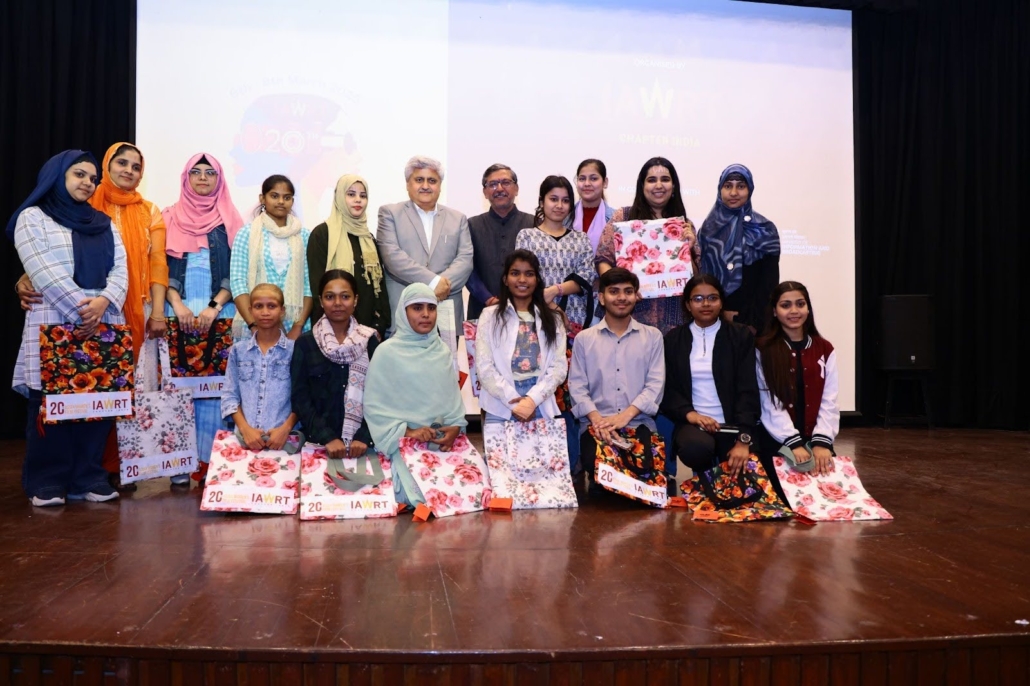
Winners were felicitated at the British Council Auditorium on March 5, 2025.
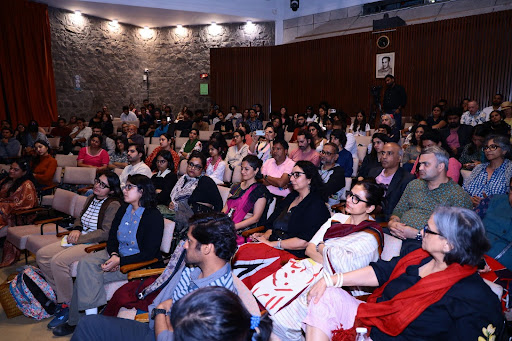
Panel Discussion – Reframing the Conversation: Women and the Arts (Mar 5, 2025) Venue: British Council Auditorium, New Delhi. Moderator: Ruchira Das, Director Arts (India), British Council
This vibrant and reflective panel explored the intersection of gender and artistic practice. It featured speakers such as Arnika Ahldag, Shweta Bhattad, and Aditi Jaitly Jadeja who brought perspectives from visual art, performance, community-based work, and curatorial practice.
Key themes:
· Structural inequality in the arts
· Representation and inclusion
· Empowerment through community-based art
· Navigating non-gender sensitized spaces
· The importance of micro-victories and mentorship
Audience feedback revealed a strong emotional and intellectual response to the conversation, with many calling it eye-opening and transformative.
20th Asian Women’s Film Festival (Mar 6–8, 2025) Venue and primary partners: India International Centre (IIC), New Delhi Films screened: 65 films from 21 Asian countries Other partners: National Film Development Corporation, French Institut India, INKO, Japan Foundation
Celebrating two decades of showcasing women’s voices in cinema, this landmark edition was a three-day celebration of artistic excellence, feminist storytelling, and cultural dialogue.
Highlights:
· Opening film: The Sharp Edge of Peace by Roya Sadat (Afghanistan)
· Closing film: A Night of Knowing Nothing by Payal Kapadia
· Curated packages such as A Room of My Own and Unsettled Reality, Tomorrow’s Imagination
· Screenings of IAWRT collaborative productions: Velvet Revolution and Displacement & Resilience
· Panels on Memory as Movement and archiving feminist histories
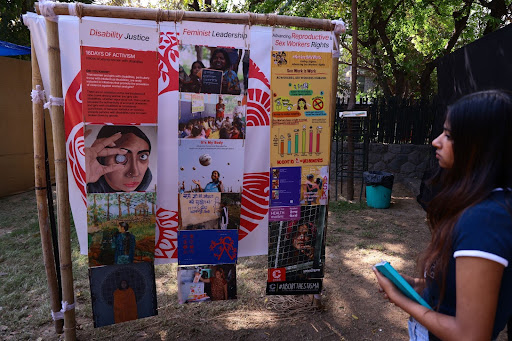
· An immersive exhibition showcasing feminist archives and storytelling through embroidery
· Masterclasses by industry leaders including Aparna Purohit and Akiko Ashizawa
· Homage to late IAWRT members Aruna Vasudev and Manjira Dutta
The festival stood out for its diverse programming, audience engagement, and its firm commitment to building an archive of women’s stories in visual media.
Conclusion
The first quarter of 2025 was a deeply fulfilling quarter for the IAWRT India Chapter, one that saw new partnerships forged, new filmmakers nurtured, and new stories brought into the spotlight. Through community-building workshops, critical conversations, and a landmark film festival, IAWRT continues to uphold its mission of amplifying women’s voices across media platforms.
https://iawrt.org/wp-content/uploads/2025/06/IAWFF-2025.jpeg341512Secretariathttp://iawrt.org/wp-content/uploads/2021/11/logo.pngSecretariat2025-03-12 18:00:002025-06-03 07:55:27IAWRT Asian Women’s Film Festival 2025
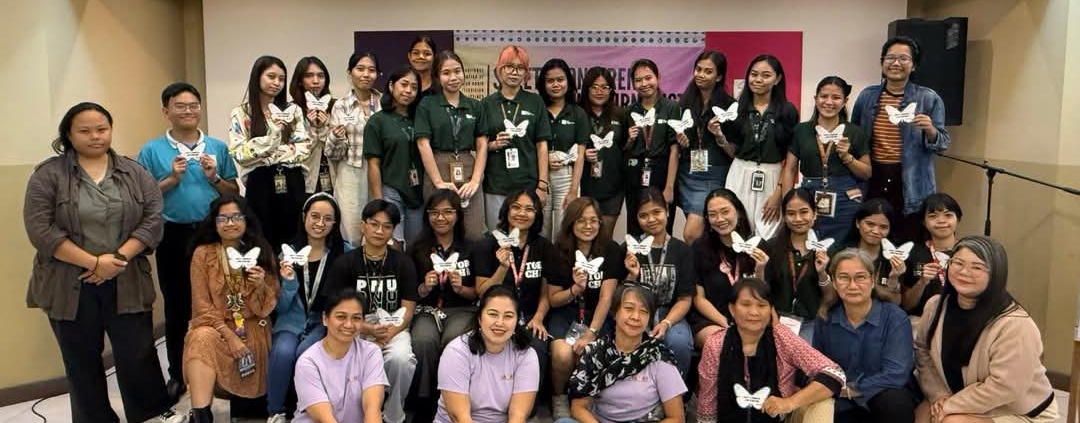
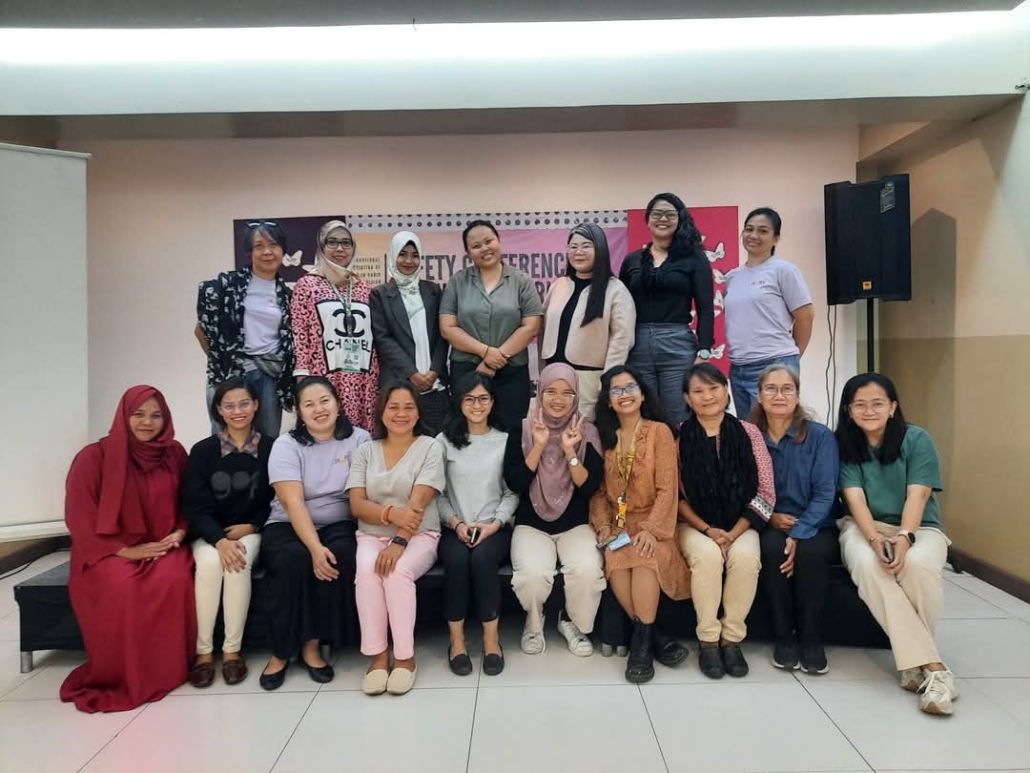
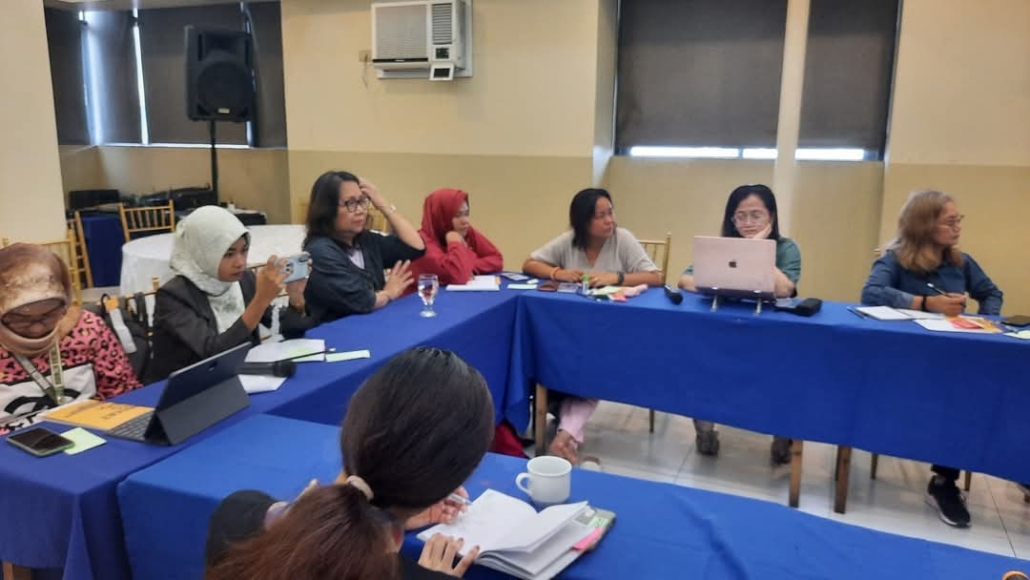
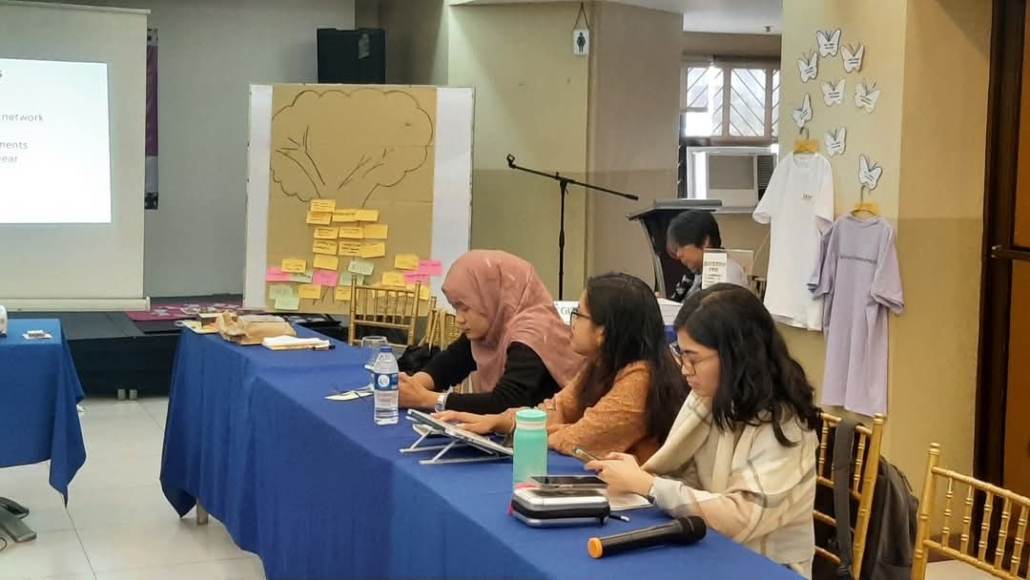
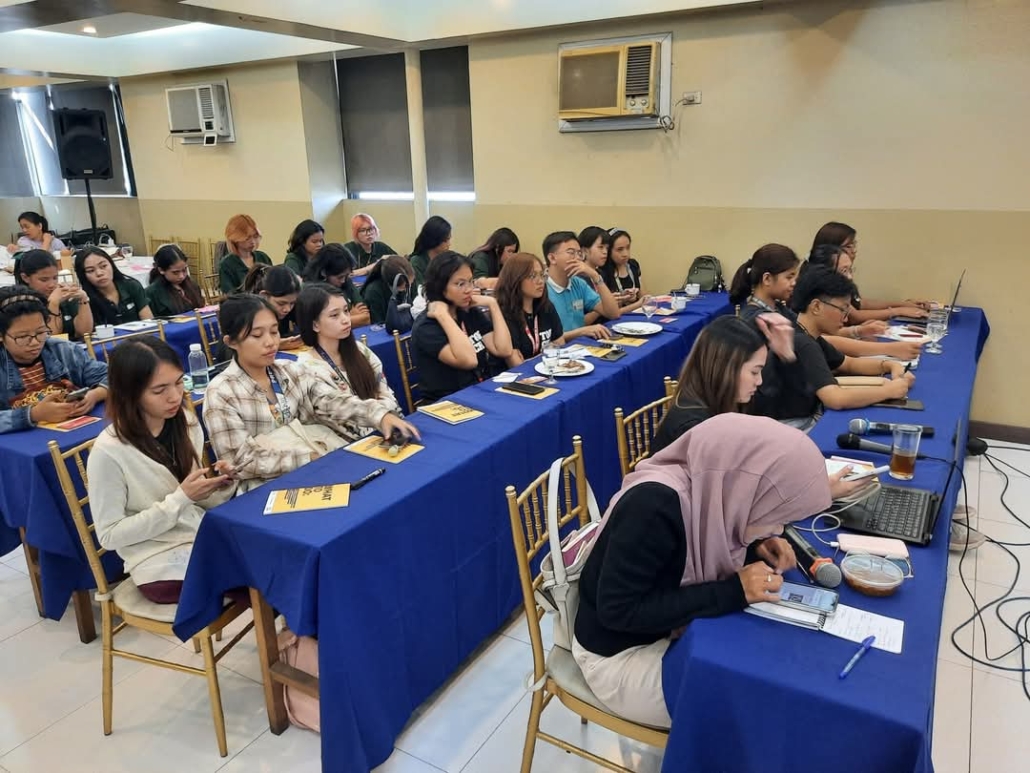
With support from the British Embassy Manila, the International Association of Women in Radio and Television (IAWRT) Philippines organized a two-day Safety Conference for Women Journalists focused on Gendered Experiences in Election Coverage on March 8-9, 2025.
The event brought together women journalists from Metro Manila, Nueva Ecija, Cotabato City, Marawi City and Davao City, offering a safe space for candid discussions around the unique challenges they face in their line of work.
On the second day of the conference, students from Cavite State University, Philippine Normal University, Polytechnic University of the Philippines, and University of Santo Tomas participated in the afternoon session. The exchange fostered a shared commitment to safeguarding women journalists.
The event coincided with the celebration of International Women’s Day.
https://iawrt.org/wp-content/uploads/2025/06/Phils-4.jpeg6031080Secretariathttp://iawrt.org/wp-content/uploads/2021/11/logo.pngSecretariat2025-03-11 19:00:002025-06-01 07:09:08Safety Conference for Women Journalists focused on Gendered Experiences in Election Coverage
IAWRT Statement on International Women’s Day, 2025
The International Association of Women in Radio and Television (IAWRT) has been at the forefront of advocating for women’s rights and gender equality in the media industry for over seven decades. As the world continues to grapple with conflicts, both armed and social, the role of gender justice has become increasingly critical. In these challenging times, where conflicts disrupt lives, communities, and nations, the pursuit of gender justice stands as a beacon for sustainable peace and development.
While women’s contribution to society, economy, the media, and all spheres of life is crucial for the well-being of our planet, this contribution is barely recognized. The hard-fought gains towards equality are under threat across the globe, as governments engage in warfare, slash social welfare, advance anti-environmental agendas, use religion and culture to deny women their rights, suppress freedom of expression, and persecute journalists.
According to the Committee for Protection of Journalists, at least 124 journalists across 18 countries were killed last year, the highest in over 3 decades. Nearly 70% of these deaths were at the hands of the Israeli military in Gaza, Lebanon, and Palestine. The Coalition for Women in Journalism reports that attacks against women journalists have nearly doubled, with 29 being killed, and over 950 reported press violations. This is a measure of the unacceptable level of conflict, political unrest, and authoritarianism in the world today, further exacerbated by the environmental impacts of climate change.
2025 is a landmark year, marking the 30th anniversary of the Beijing Declaration and Platform for Action, adopted at the Fourth World Conference on Women in 1995 by 189 governments. As a blueprint for the rights of women and girls, the Platform remains ever relevant, even as armed conflict, climate change, and digital media continue to reshape the world. In this context, we strongly endorse and amplify the call by UN Women for International Women’s Day this year: “For ALL women and girls: Rights. Equality. Empowerment.”
This call resonates across our chapters worldwide: from Afghanistan, where our members live in fear, hiding or exile; from Iraq Kurdistan, where women journalists face multiple challenges; from the Philippines, where our member, Frenchie May Cumpio remains unjustly imprisoned; from Nepal, where gender discrimination in the media persists; from India, where freedom of expression is under severe attack; from Kenya, where sexual harassment and discrimination remain widespread, and from all other chapters and countries, where our members, along fellow women journalists and media workers, resist right-wing regimes that rule through disinformation, censorship, and policies that harm women and girls, particularly from marginalized communities. In this increasingly hostile environment, our members continue their work for justice and safety through their reporting and creative endeavours.
As we approach our 40th Biennial Conference in Nepal, IAWRT reaffirms its unwavering commitment to Gender Justice, Equality and Empowerment.
We invite you to support our work by donating to our fundraiser: Building Global Sisterhood and Forging New Ways Forward.
Link to the fundraising page:
https://gofund.me/299ea014
March 8, 2025
https://iawrt.org/wp-content/uploads/2025/06/IAWRT-logo.png24004800Secretariathttp://iawrt.org/wp-content/uploads/2021/11/logo.pngSecretariat2025-03-08 18:00:002025-06-01 07:24:26Towards Gender Justice amidst Conflict and Discrimination